
Table Of Contents
- Introduction
- Understanding Emergenetics: The Science of Thinking Preferences
- Exploring the Enneagram: Nine Personality Types
- Key Differences Between Emergenetics and Enneagram
- Comparative Analysis: Thinking Styles and Personality Types
- Practical Applications in Personal and Professional Development
- Combining Frameworks for Deeper Insights
- Choosing the Right Tool for Your Development Needs
- Conclusion
In the landscape of personality assessments and cognitive profiling, two frameworks have gained significant traction for their unique approaches to understanding human behavior and thinking patterns: Emergenetics and Enneagram. While both tools offer valuable insights into how individuals perceive the world and interact with others, they approach personality typing from distinctly different angles.
Emergenetics focuses on thinking preferences and behavioral attributes based on neuroscience research, offering a blend of nature and nurture perspectives. The Enneagram, with its ancient origins and modern psychological applications, maps nine fundamental personality types and their complex interconnections. Understanding the similarities, differences, and complementary aspects of these two frameworks can provide profound insights for personal development, team building, and organizational effectiveness.
This comprehensive comparison will explore how these two systems map thinking styles to personality types, helping you determine which framework—or combination of frameworks—might best serve your development goals and learning objectives.
Understanding Emergenetics: The Science of Thinking Preferences
Emergenetics stands at the intersection of neuroscience, psychology, and adult learning theory. Developed by Dr. Geil Browning and Wendell Williams in the 1990s after extensive research, Emergenetics Profiling offers a scientifically-validated approach to understanding how people think and behave.
The Four Thinking Attributes
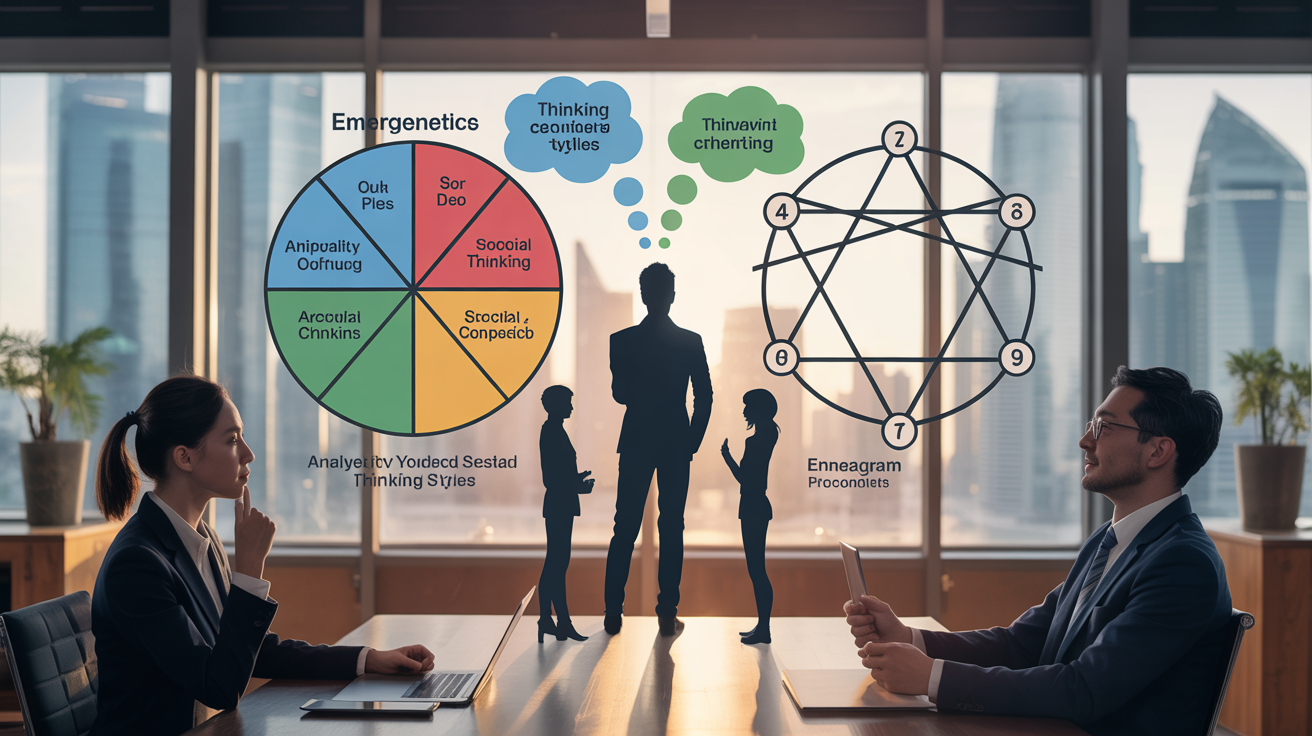
At its core, Emergenetics identifies four distinct thinking attributes that influence how individuals process information and approach problems:
Analytical: People with analytical thinking preferences value logic, data, and rational approaches. They tend to be clear-thinking, objective, and intellectually disciplined. These individuals excel at critical analysis, evaluating options based on facts, and making decisions through logical reasoning.
Structural: Those with structural preferences appreciate organization, planning, and established processes. They typically approach tasks sequentially, value practical solutions, and prefer concrete guidelines. Structural thinkers excel at creating systems, following through on details, and implementing plans methodically.
Social: Individuals with social thinking preferences emphasize relationships, emotional connections, and interpersonal dynamics. They often process information by considering how decisions affect people, value collaboration, and excel at building consensus. These thinkers naturally consider the human element in every situation.
Conceptual: People with conceptual preferences gravitate toward innovation, imagination, and future possibilities. They enjoy abstract thinking, making connections between seemingly unrelated concepts, and exploring novel approaches. Conceptual thinkers excel at big-picture visioning and thinking outside conventional boundaries.
The Three Behavioral Attributes
Complementing the thinking attributes, Emergenetics also identifies three behavioral attributes that describe how individuals express themselves and interact with the world:
Expressiveness: This spectrum measures how a person communicates their thoughts and emotions, ranging from quiet and reflective to gregarious and demonstrative.
Assertiveness: This attribute reflects how a person advances their thoughts, ideas, and feelings, from peacekeeping and accommodating to driving and direct.
Flexibility: This spectrum indicates how willingly a person accommodates the thoughts and actions of others, ranging from focused and firm to adaptable and accommodating.
Through Emergenetics Workshop & Programmes, individuals receive a personalized Emergenetics Profile that maps their unique combination of these seven attributes. Unlike many personality assessments that put people in boxes, Emergenetics acknowledges that individuals possess all thinking and behavioral attributes to varying degrees, creating a unique “fingerprint” for each person.
Exploring the Enneagram: Nine Personality Types
The Enneagram represents a more traditional approach to personality typing, with roots that some scholars trace back to ancient wisdom traditions. Its modern psychological application emerged in the 20th century through the work of Oscar Ichazo, Claudio Naranjo, and later Don Richard Riso and Russ Hudson, among others.
The Nine Personality Types
The Enneagram identifies nine distinct personality types, each with its own core motivations, fears, and patterns of thinking and behaving:
Type 1 – The Perfectionist: Principled, purposeful, and self-controlled, Type 1s strive for integrity and improvement. They’re driven by a desire to be good, correct, and ethical, often fearing mistakes and imperfection.
Type 2 – The Helper: Generous, people-pleasing, and possessing a desire to feel needed, Type 2s focus on relationships and meeting others’ needs. They fear being unwanted or unworthy of love.
Type 3 – The Achiever: Success-oriented, pragmatic, and image-conscious, Type 3s adapt to excel and achieve recognition. They fear failure and worthlessness.
Type 4 – The Individualist: Creative, sensitive, and self-aware, Type 4s seek authenticity and depth of feeling. They fear having no identity or personal significance.
Type 5 – The Investigator: Perceptive, innovative, and isolated, Type 5s focus on building knowledge and conserving energy. They fear depletion and being overwhelmed by demands.
Type 6 – The Loyalist: Committed, security-focused, and engaging, Type 6s seek safety and support. They fear being without guidance or support.
Type 7 – The Enthusiast: Spontaneous, versatile, and scattered, Type 7s seek experiences and excitement. They fear missing out on joy or being deprived.
Type 8 – The Challenger: Self-confident, decisive, and confrontational, Type 8s desire control and protect themselves and others. They fear being harmed or controlled by others.
Type 9 – The Peacemaker: Receptive, reassuring, and complacent, Type 9s seek harmony and avoid conflict. They fear loss and separation from others.
Wings, Levels, and Directions of Integration
The Enneagram goes beyond basic type descriptions by incorporating several layers of complexity:
Wings: Each personality type is influenced by the adjacent types (called “wings”), which add nuance to how the core type expresses itself. For example, a Type 1 might have a strong Type 2 wing (noted as 1w2) or a Type 9 wing (1w9).
Levels of Development: Each type can function at different levels of psychological health or development, from highly integrated and self-actualized to unhealthy and dysfunctional.
Directions of Integration/Disintegration: The Enneagram model suggests that under stress or security, individuals move toward the characteristics of other specific types, creating dynamic patterns of growth and regression.
Key Differences Between Emergenetics and Enneagram
While both Emergenetics and Enneagram provide valuable insights into human psychology and behavior, they differ significantly in their approach, focus, and applications.
Foundational Philosophy
Emergenetics is grounded in neuroscience and psychometric research, developed through statistical validation and modern psychological principles. It focuses on the measurable aspects of thinking preferences and observable behaviors.
Enneagram draws from diverse traditions including spiritual wisdom, philosophy, and psychology. Its development has been more intuitive and observational, integrating ancient wisdom with modern psychological concepts.
Focus of Assessment
Emergenetics emphasizes how people think and behave in the present, focusing on cognitive preferences and behavioral tendencies that influence day-to-day interactions and work styles.
Enneagram delves deeper into motivations, fears, and unconscious drivers, exploring why people think and behave as they do based on core emotional patterns often established in childhood.
Stability vs. Transformation
Emergenetics generally views thinking preferences as relatively stable aspects of personality, while acknowledging that behaviors can be adapted and modified based on context and conscious choice.
Enneagram explicitly focuses on personal transformation, identifying patterns of thought and behavior that can be transcended as individuals develop greater self-awareness and psychological health.
Comparative Analysis: Thinking Styles and Personality Types
When mapping Emergenetics thinking attributes to Enneagram personality types, some interesting patterns emerge, though it’s important to note that there isn’t a one-to-one correspondence between these systems.
Potential Correlations
Analytical Thinking and Enneagram Types: Enneagram Types 5 (The Investigator) and 1 (The Perfectionist) often demonstrate strong analytical thinking preferences, though for different reasons. Type 5s analyze to build knowledge and understand complex systems, while Type 1s use analytical thinking to determine what is correct and optimal.
Structural Thinking and Enneagram Types: Enneagram Types 1 (The Perfectionist) and 6 (The Loyalist) frequently exhibit structural thinking preferences. Type 1s create systems to maintain order and correctness, while Type 6s establish structures to create security and predictability.
Social Thinking and Enneagram Types: Enneagram Types 2 (The Helper), 9 (The Peacemaker), and sometimes 3 (The Achiever) often show strong social thinking preferences. Type 2s focus on interpersonal connections, Type 9s on maintaining harmony, and Type 3s on social perception and impact.
Conceptual Thinking and Enneagram Types: Enneagram Types 4 (The Individualist), 7 (The Enthusiast), and sometimes 8 (The Challenger) frequently demonstrate conceptual thinking preferences. Type 4s use conceptual thinking creatively and introspectively, Type 7s to generate possibilities and connections, and Type 8s to envision strategic opportunities.
Through Corporate and Personal Development Programmes, individuals can explore these correlations and gain deeper insights into their cognitive and personality profiles.
Practical Applications in Personal and Professional Development
Both Emergenetics and Enneagram offer valuable applications in various contexts, from individual growth to team development and organizational effectiveness.
Emergenetics Applications
Team Composition and Dynamics: Emergenetics Profiling excels at helping teams understand their collective thinking preferences, identifying potential blind spots and leveraging cognitive diversity for enhanced problem-solving and innovation.
Communication Effectiveness: By understanding others’ thinking preferences, individuals can adapt their communication style to increase clarity and impact. For example, when presenting to someone with strong Analytical preferences, leading with data and logical reasoning increases effectiveness.
Leadership Development: Leaders can use Emergenetics insights to flex their leadership approach based on team members’ preferences, making their guidance more accessible and impactful across diverse thinking styles.
Meeting Management: The Whole Emergenetics approach encourages meeting facilitators to include activities that engage all four thinking preferences, ensuring more comprehensive and effective discussions.
Enneagram Applications
Self-Awareness and Personal Growth: The Enneagram provides a deep framework for understanding one’s core motivations, blind spots, and patterns of behavior, especially under stress.
Conflict Resolution: By understanding the underlying fears and desires driving different Enneagram types, teams can address conflicts more compassionately and effectively.
Emotional Intelligence: The Enneagram helps individuals recognize and manage their emotional reactions, especially habitual patterns that may no longer serve them well.
Career Development: Understanding one’s Enneagram type can provide insights into environments, roles, and work styles that might be particularly energizing or draining.
Combining Frameworks for Deeper Insights
While valuable individually, Emergenetics and Enneagram can be even more powerful when used together as complementary tools for personal and professional development.
The Power of Integration
Emergenetics provides clarity about how individuals think and behave in the present, while Enneagram offers insights into why they might gravitate toward certain patterns based on deeper motivations and fears. Together, they create a more complete picture of the individual:
Cognitive-Emotional Connection: Emergenetics reveals thinking preferences, while Enneagram illuminates the emotional drivers behind those preferences. For example, a person might demonstrate strong Analytical thinking (Emergenetics) because they’re a Type 5 seeking mastery and competence or a Type 6 seeking certainty and security (Enneagram).
Development Pathways: The combination of these frameworks can suggest more targeted development opportunities. Understanding both how you think (Emergenetics) and why certain patterns emerge under stress (Enneagram) provides multiple angles for growth work.
Team Dynamics: In team settings, understanding both the thinking preferences and core motivations of team members creates a richer foundation for collaboration, conflict resolution, and mutual support.
Through S.M.A.R.T Play Experiences, teams can explore these integrated frameworks in engaging, experiential learning environments that make abstract concepts tangible and applicable.
Choosing the Right Tool for Your Development Needs
When deciding which framework might be most valuable for your specific context, consider these guiding questions:
When Emergenetics Might Be Most Valuable
Team Formation and Development: Are you building a new team or trying to enhance collaboration within an existing one? Emergenetics offers immediate insights into thinking diversity and communication preferences that can accelerate team effectiveness.
Practical Work Applications: Do you need practical tools for enhancing day-to-day interactions, meetings, and project approaches? Emergenetics provides concrete strategies for adapting communication and work processes to diverse thinking styles.
Organizational Culture: Are you working to create a culture that values cognitive diversity and leverages different thinking styles? Emergenetics provides a non-judgmental language for discussing and appreciating differences.
When Enneagram Might Be Most Valuable
Personal Transformation: Are you or your team members seeking deeper personal growth and understanding of habitual patterns? The Enneagram provides a roadmap for psychological development and transcending limiting behaviors.
Leadership Coaching: Are you working with leaders who need to understand their blind spots and automatic reactions, especially under stress? The Enneagram excels at illuminating these patterns.
Long-term Development: Are you engaged in a long-term development journey rather than seeking immediate practical applications? The Enneagram offers layers of insight that can be explored over years of reflection and growth.
Conclusion
Both Emergenetics and Enneagram offer valuable lenses through which to understand human cognition, behavior, and personality. Emergenetics, with its foundation in neuroscience and focus on thinking preferences and behavioral attributes, provides practical insights for enhancing communication, collaboration, and cognitive diversity. The Enneagram, with its exploration of core motivations, fears, and paths to integration, offers profound insights for personal transformation and emotional intelligence.
Rather than viewing these as competing frameworks, the most powerful approach may be to recognize them as complementary tools that illuminate different aspects of human experience. Emergenetics helps us understand how we and others think and behave, while the Enneagram helps us understand why we gravitate toward certain patterns and how we might transcend limitations.
In today’s complex personal and professional environments, having access to multiple frameworks for understanding human behavior provides a richer vocabulary for self-awareness, empathy, and effective collaboration. Whether you’re focused on team development, leadership growth, or personal transformation, both Emergenetics and Enneagram offer valuable maps for the journey.
Ready to explore how Emergenetics or Enneagram frameworks can enhance your personal development or transform your team’s dynamics? Trost Learning offers specialized workshops and programmes tailored to your specific learning objectives. Contact us today to discover how we can design a customized learning experience that empowers your growth journey.