
Science-Based Team-Building Techniques That Transform Workplace Dynamics

Post

In today’s rapidly evolving workplace, effective team building has evolved far beyond trust falls and icebreakers. Organizations are increasingly turning to evidence-based approaches that deliver measurable results and lasting impact. But what exactly makes team building effective from a scientific perspective?

Research consistently shows that high-performing teams share specific characteristics: psychological safety, clear communication patterns, cognitive diversity, and aligned mental models. These aren’t soft, unmeasurable concepts—they’re backed by decades of organizational psychology research and have direct implications for productivity, innovation, and employee satisfaction.

At Trost Learning, we’ve witnessed how science-based team building transforms workplace dynamics across our 800+ programmes delivered to over 25,000 participants. This article explores the research behind effective team building and provides actionable techniques for developing stronger, more cohesive teams that drive organizational success. Whether you’re addressing communication challenges, navigating team conflicts, or simply seeking to elevate team performance, these evidence-based approaches will help you build teams that collaborate effectively and innovate consistently.

Science-Based Team-Building Techniques

Research-backed strategies that transform workplace dynamics

The Science Behind Effective Teams

High-performing teams aren’t created by chance—they’re built through evidence-based practices focused on key dynamics.

Research-Backed Success Factors

Psychological Safety

Google’s research identified this as the #1 factor in effective teams. Safe environments encourage risk-taking and innovation.

Cognitive Diversity

Teams with diverse thinking styles solve problems faster and more effectively than homogeneous groups.

Communication Patterns

MIT research shows communication patterns are the strongest predictor of team success. Balanced participation is key.

Shared Mental Models

Teams with common understanding of goals, roles, and processes demonstrate superior coordination under pressure.

Implementing Evidence-Based Team Building

3 Research-Backed Activities

1
Perspective-Taking Exercises

Role reversal dialogues where team members advocate for perspectives different from their own.

2
Structured Reflection

After Action Reviews improve team performance by ~20% compared to teams that don’t reflect.

3
Collaborative Problem-Solving

Design challenges requiring diverse thinking and structured debriefs for maximum impact.

Measuring Team-Building ROI

Process Metrics
  • Communication patterns
  • Psychological safety levels
  • Collaboration quality
  • Decision-making efficiency
Outcome Metrics
  • Productivity improvements
  • Innovation outcomes
  • Error rate reduction
  • Employee satisfaction
KEY INSIGHT

Sustainability Is Critical

Research shows one-off team events rarely create lasting change. Sustainable team development requires:

Integration into daily work processes

Ongoing leadership reinforcement

Regular team reflection rituals

Continuous feedback loops

When teams develop psychological safety, leverage cognitive diversity, build shared mental models, and engage in structured reflection, they achieve demonstrably higher performance.

Learn more about evidence-based team building

Understanding the Science of Team Building

Team building is often misunderstood as a collection of fun activities designed to improve morale. While enjoyment certainly has its place, the science of team building goes much deeper. Research from MIT’s Human Dynamics Laboratory has shown that the patterns of communication within teams are the single most important predictor of team success. These communication patterns—who talks to whom, how often, for how long, and in what contexts—create what researchers call the “team chemistry” that drives performance.

According to a landmark study published in Science by Anita Woolley and Thomas Malone, high-performing teams demonstrate specific measurable characteristics: they distribute conversational turn-taking fairly evenly, they have high levels of social sensitivity (the ability to read emotional states), and they include diverse perspectives. These factors contribute more to collective intelligence than individual IQ scores of team members.

What does this mean for practical team building? It means that effective team development must focus on creating communication structures and social dynamics that enable these patterns to emerge naturally. Simply putting talented individuals together doesn’t automatically create a high-performing team—the interactions between members matter more than individual brilliance.

At Trost Learning, we’ve seen how understanding these scientific principles transforms team development interventions from one-time events into sustainable improvement processes. Our approach integrates these research insights into practical frameworks that teams can apply in their day-to-day operations.

Psychological Safety: The Foundation of Effective Teams

Google’s extensive Project Aristotle research identified psychological safety as the most critical factor in team effectiveness. Psychological safety, a concept pioneered by Harvard researcher Amy Edmondson, refers to the shared belief that the team is safe for interpersonal risk-taking. In psychologically safe teams, members feel comfortable speaking up, sharing ideas, admitting mistakes, and asking questions without fear of embarrassment or punishment.

The research is clear: teams with high psychological safety outperform those without it. They demonstrate higher levels of innovation, better problem-solving, reduced turnover, and greater ability to learn from failures. This isn’t surprising when we consider that innovation requires risk-taking and vulnerability—precisely what psychological safety enables.

Building psychological safety isn’t achieved through a single team-building event. Rather, it’s cultivated through consistent leadership behaviors and team practices that demonstrate value for vulnerability and diverse perspectives. Leaders play a crucial role by modeling vulnerability themselves, acknowledging their own limitations, and responding constructively when team members take risks.

Practical techniques for building psychological safety include:

  • Establishing communication norms that encourage equal participation
  • Creating structured opportunities for all voices to be heard
  • Responding to mistakes with curiosity rather than blame
  • Acknowledging and addressing power dynamics within the team
  • Regularly soliciting feedback and demonstrating that it’s valued

These practices create the foundation upon which all other team development efforts can build. Without psychological safety, even the most innovative team-building approaches will struggle to create lasting impact.

Cognitive Diversity: Leveraging Different Thinking Patterns

While demographic diversity receives significant attention in workplace discussions, cognitive diversity—differences in how people think, process information, and solve problems—is equally crucial for team effectiveness. Research published in the Harvard Business Review demonstrates that teams with higher cognitive diversity solve problems faster and more effectively than homogeneous teams.

Cognitive diversity encompasses various dimensions of thinking: analytical versus intuitive approaches, risk tolerance, communication preferences, and problem-solving styles. Understanding these differences allows teams to leverage complementary strengths rather than experiencing them as sources of friction.

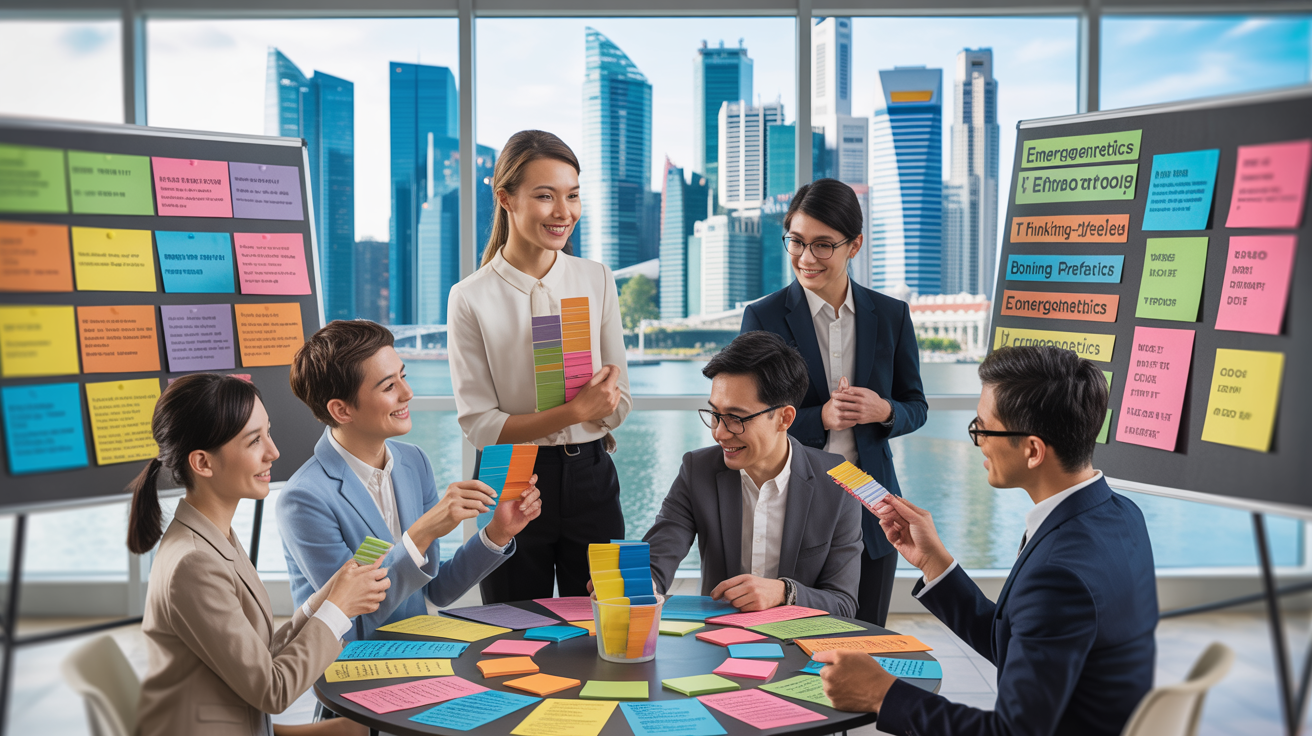
Emergenetics Profiling stands as one of the most effective frameworks for understanding cognitive diversity in workplace settings. This scientifically-validated assessment helps teams understand different thinking preferences and behavioral attributes, creating a common language for discussing cognitive differences constructively.

Through our Emergenetics Workshop & Programmes, teams learn to recognize how different thinking preferences contribute to innovation and problem-solving. Rather than trying to minimize differences, teams learn to intentionally leverage diverse cognitive approaches for better outcomes.

The research shows that cognitive diversity yields greatest benefits when teams:

  1. Have a shared understanding of different thinking preferences
  2. Value diverse approaches rather than seeking consensus too quickly
  3. Match tasks with appropriate thinking styles
  4. Create inclusive processes that accommodate different work preferences
  5. Build meta-cognition—awareness of how the team is thinking about problems

When teams understand and leverage cognitive diversity, they access a wider range of solutions and develop greater adaptability in the face of complex challenges.

Shared Mental Models: Aligning Team Perspectives

While celebrating cognitive diversity, high-performing teams also develop shared mental models—common understanding of goals, roles, processes, and contexts. Research from the Journal of Applied Psychology shows that teams with well-developed shared mental models demonstrate superior coordination and performance, especially under pressure.

Shared mental models don’t mean everyone thinks alike; rather, they create alignment around key aspects of work while still leveraging diverse perspectives. They function like a shared operating system that allows team members to predict each other’s needs, coordinate effectively, and make decisions efficiently.

Developing shared mental models requires intentional practices:

  • Creating explicit clarity around goals, priorities, and success criteria
  • Establishing shared language and frameworks for discussing work
  • Developing clear role expectations and understanding of interdependencies
  • Regular reflection on processes and ongoing calibration of perspectives

Through our Corporate and Personal Development Programmes, we facilitate structured conversations that help teams develop these shared models while still honoring individual perspectives. The key is finding the right balance between alignment and autonomy—enough shared understanding to coordinate effectively while maintaining space for diverse thinking.

Research-Backed Team-Building Activities

With the foundational science established, let’s explore specific team-building techniques that research has shown to be effective. Unlike traditional team-building activities that may provide momentary enjoyment but little lasting impact, these approaches address the core elements of team effectiveness.

Perspective-Taking Exercises

Research published in the Journal of Personality and Social Psychology demonstrates that perspective-taking exercises significantly improve collaboration and reduce conflict in diverse teams. These activities involve structured opportunities for team members to understand others’ viewpoints, constraints, and priorities.

One effective technique involves “role reversal dialogues” where team members advocate for perspectives different from their own. For example, in a cross-functional team, the marketing representative might present the technical constraints that engineering faces, while the engineer articulates marketing’s customer-focused concerns. This practice builds cognitive empathy—the intellectual understanding of others’ perspectives—which research shows is more sustainable in workplace settings than emotional empathy alone.

These exercises are particularly valuable for teams experiencing functional silos or recurring conflicts. By temporarily stepping into different perspectives, team members develop greater appreciation for diverse viewpoints and identify integration points that might otherwise be overlooked.

Structured Reflection Protocols

Teams that regularly reflect on their processes outperform those that don’t, according to research from Harvard Business School. Structured reflection protocols provide frameworks for teams to examine their performance, identify learning opportunities, and adapt accordingly.

The After Action Review (AAR), originally developed by the U.S. Army and validated through extensive research, offers a simple but powerful framework:

  1. What was expected to happen?
  2. What actually happened?
  3. What caused the differences?
  4. What will we sustain or improve?

This protocol creates psychological safety by focusing on learning rather than blame, and it builds shared mental models by aligning the team’s understanding of events and causes. Research shows that teams that regularly use structured reflection improve their performance by approximately 20% compared to teams that don’t engage in reflection.

At Trost Learning, we’ve enhanced traditional reflection protocols by integrating playful elements through our S.M.A.R.T Play Experiences, making reflection more engaging and accessible for diverse teams. These approaches maintain the scientific rigor of traditional protocols while adding elements that increase participation and enjoyment.

Collaborative Problem-Solving

Well-designed collaborative problem-solving activities create what psychologists call “productive struggle”—challenges that require coordinated effort and diverse thinking to overcome. Research from organizational psychology shows that shared challenges, when properly structured, build stronger bonds than purely social activities.

The key is designing problems that:

  • Require diverse perspectives to solve effectively
  • Have multiple valid approaches rather than a single right answer
  • Create interdependence without unnecessary competition
  • Reflect real workplace challenges in abstracted forms
  • Include structured debriefs that connect insights to workplace applications

These activities are most effective when they’re designed with specific team development goals in mind. Generic team challenges may provide entertainment, but targeted problem-solving experiences that address specific team needs create lasting development. This is why our approach at Trost Learning focuses on customized design rather than off-the-shelf activities.

Measuring Team-Building Effectiveness

For team building to be truly science-based, it must include measurement of outcomes. Too often, organizations invest in team development without clear metrics for success. Research from the Center for Creative Leadership suggests that effective team building measurement includes both process metrics (how the team works together) and outcome metrics (what the team achieves).

Comprehensive measurement includes:

  1. Baseline assessment: Measuring team functioning before interventions
  2. Process indicators: Tracking changes in communication patterns, psychological safety levels, and collaboration quality
  3. Performance outcomes: Measuring improvements in productivity, innovation, decision quality, and error rates
  4. Sustainability tracking: Following up to ensure improvements persist over time

Valid measurement doesn’t require complex instruments. Simple pulse surveys, structured observations, and performance data can provide valuable insights when collected systematically. The key is establishing clear, relevant metrics tied to the specific development goals of the team.

By establishing measurement protocols, organizations transform team building from a periodic event into a continuous improvement process with demonstrable ROI.

Implementing Sustainable Team Development

Research consistently shows that one-off team-building events, however well-designed, rarely create lasting change. Sustainable team development requires integration into the team’s ongoing operations and culture. A meta-analysis published in the Journal of Applied Psychology found that team development interventions were most effective when reinforced through regular practice and leadership support.

Implementing sustainable team development involves:

  • Integrating team-building principles into regular work processes
  • Creating microlearning opportunities that don’t require dedicated off-site time
  • Developing team leaders’ capacity to reinforce positive practices
  • Establishing team rituals that support psychological safety and inclusion
  • Creating feedback loops that allow continuous improvement

This approach recognizes that team development happens primarily through daily interactions, not special events. While dedicated team-building sessions remain valuable for focused development and relationship building, their impact depends on how well the principles transfer to everyday work.

Our experience with clients across Asia Pacific has shown that organizations achieve the greatest return on their team development investment when they combine targeted interventions with ongoing support and reinforcement. This blended approach creates the conditions for sustained behavior change and continuous team improvement.

Conclusion: Building Teams That Thrive

The science of team building has evolved dramatically in recent years, moving from intuition-based approaches to evidence-based methodologies with measurable outcomes. Research consistently shows that effective teams aren’t created through random activities but through intentional development of key dynamics: psychological safety, cognitive diversity, shared mental models, and structured collaboration processes.

While team-building activities can be enjoyable—and there’s value in shared positive experiences—the most effective approaches focus on creating sustainable changes in how teams interact daily. By grounding team development in organizational psychology research and measuring outcomes systematically, organizations can transform team building from a periodic event into a continuous improvement process.

The science is clear: when teams develop psychological safety, leverage cognitive diversity, build shared mental models, and engage in structured reflection, they achieve higher levels of performance, innovation, and satisfaction. And while these outcomes benefit organizations through improved results, they also create more fulfilling work experiences for team members—a truly win-win proposition.

As work becomes increasingly complex and interdependent, the ability to build and sustain effective teams becomes a critical organizational capability. By embracing evidence-based approaches to team development, organizations can create teams that don’t just survive but truly thrive in challenging environments.

Ready to transform your team with science-based approaches that deliver measurable results? Trost Learning’s team development experts can help you design and implement evidence-based team building that creates lasting impact. Contact us today to discuss how our research-backed methodologies can address your specific team challenges and development goals.

Schedule a Consultation

CSR-Focused Team-Building: Transforming Corporate Volunteering into Measurable Business Impact

Post

In today’s purpose-driven business landscape, corporate social responsibility (CSR) has evolved far beyond charitable donations or obligatory community service days. Forward-thinking organizations are discovering a powerful synergy: integrating meaningful volunteer work with strategic team-building initiatives. This approach not only benefits communities but also creates measurable business impact through enhanced employee engagement, skill development, and organizational cohesion.

At Trost Learning, we’ve witnessed firsthand how CSR-focused team-building transforms both communities and corporate cultures across Asia Pacific. When thoughtfully designed, these initiatives become powerful catalysts for developing purpose-driven, people-centred, and future-ready teams. This article explores how to create, implement, and measure CSR team-building activities that deliver genuine value to all stakeholders—from employees and leadership to community partners and business objectives.

CSR-Focused Team-Building

From Corporate Volunteering to Business Impact

Purpose-driven CSR volunteering creates a powerful synergy between community impact and team development, delivering measurable business benefits while addressing social needs.

Core Business Benefits

Enhanced Engagement

Employees finding work meaningful are 1.7x more satisfied and 1.4x more engaged, leading to 17% higher productivity.

Skill Development

CSR activities develop critical workplace skills through real-world application, aligning with the 70-20-10 learning model where experiential learning drives retention.

Breaking Down Silos

CSR activities naturally dismantle hierarchies by placing employees from different departments in situations where titles matter less than talents and contributions.

Effective CSR Team-Building Framework

1

Align with Values

Design CSR initiatives that reflect organizational values and leverage company expertise to address community needs authentically.

2

Meaningful Participation

Create varied roles that leverage different strengths and preferences, ensuring everyone can contribute meaningfully regardless of position.

3

Structured Reflection

Facilitate reflection sessions that connect volunteer experiences to workplace applications, reinforcing learning and creating lasting change.

Measuring Multi-Dimensional Impact

Community Impact

Quantify tangible outcomes: area restored, people served, resources created, and qualitative impact on community partners.

Team Development

Assess collaboration effectiveness, psychological safety, and communication quality through pre/post measurements.

Business Performance

Track correlations between CSR participation and business KPIs: engagement scores, retention rates, innovation metrics, and productivity.

Success Story Highlights

Tech Company Digital Literacy Initiative

500+ seniors reached34% collaboration increase

Cross-functional teams developed digital literacy programs for seniors, breaking down silos while improving product documentation and client communication.

Bank Environmental Leadership Project

3 hectares restored40% leadership flexibility gain

Managers developed leadership flexibility by rotating through different leadership styles in conservation projects, with 78% applying learnings to workplace challenges.

Transform Your Team-Building Approach

Develop purpose-driven teams while creating meaningful community impact

Trost Learning • Creating Transformative Learning Experiences

Understanding CSR-Focused Team-Building

CSR-focused team-building represents the intersection of purpose and performance—where doing good and building stronger teams become mutually reinforcing goals. Unlike traditional team-building activities that might involve escape rooms or cooking classes, CSR initiatives connect employees to meaningful community impact while simultaneously developing crucial workplace skills and relationships.

This approach aligns perfectly with today’s workforce expectations. According to Deloitte’s Global Human Capital Trends survey, 86% of millennials believe business success should be measured by more than financial performance. Meanwhile, 77% of employees consider a company’s purpose when deciding where to work. By embedding social responsibility into team development, organizations address this growing demand for meaningful work while building stronger teams.

The Evolution from Traditional Team-Building

Traditional team-building often focuses exclusively on internal dynamics—communication, trust, and collaboration within the team. While these elements remain important, CSR-focused activities expand the scope to include external impact and purpose. This evolution offers several advantages:

First, it creates authentic situations where team members must collaborate to solve real challenges—not contrived scenarios. Second, it introduces a meaningful purpose that elevates motivation and engagement beyond what’s possible in conventional team activities. Finally, it develops empathy and perspective-taking abilities that transfer directly to customer and stakeholder relationships.

The key difference lies in sustainability: While traditional team-building might create a temporary boost in morale, purpose-driven CSR initiatives often deliver lasting impact on team culture and individual development. They connect daily work to larger meaning—a powerful motivator for the modern workforce.

Business Benefits of CSR Team-Building

When strategically designed, CSR-focused team-building delivers measurable business benefits that extend far beyond the feelgood factor. These initiatives create both immediate team development and long-term organizational advantages:

Enhanced Employee Engagement

Research consistently shows that purpose-driven work dramatically increases engagement. According to Gallup, employees who find their work meaningful demonstrate 1.7 times higher job satisfaction and are 1.4 times more engaged than those who don’t. This translates directly to productivity—with engaged employees showing 17% higher productivity and 21% greater profitability.

CSR team-building provides a tangible connection to purpose. When employees renovate a shelter together, mentor disadvantaged youth, or develop solutions for environmental challenges, they experience firsthand the impact of their collective effort. This shared experience of meaningful contribution builds emotional investment in both the team and the organization’s larger mission.

Skill Development Through Real-World Application

Volunteer-based team activities create natural opportunities to develop and practice critical workplace skills in authentic contexts. Project management, leadership, communication, problem-solving, adaptability—these competencies emerge organically when teams tackle community challenges together.

For instance, organizing a community garden project requires the same planning, delegation, and execution skills as managing a complex work project. The difference lies in context: applying these skills to help others creates deeper learning and stronger retention than traditional training methods. According to the 70-20-10 model of learning and development, people retain only 10% of what they learn through formal instruction but 70% through challenging experiences and problem-solving—exactly what CSR activities provide.

Breaking Down Silos and Hierarchies

Few business challenges are more persistent than organizational silos and rigid hierarchies that impede collaboration and innovation. CSR team-building naturally dismantles these barriers by placing employees from different departments, levels, and backgrounds in situations where titles matter less than talents and contributions.

When the senior executive and the new hire work side-by-side building homes or teaching technology skills, traditional power dynamics recede. New connections form based on shared values and complementary abilities rather than organizational charts. These relationships often translate back to the workplace, creating cross-functional networks that enhance innovation and operational efficiency.

Designing Effective CSR Team-Building Activities

Creating impactful CSR team-building experiences requires thoughtful design that balances community needs, organizational objectives, and employee development goals. The most successful initiatives follow these principles:

Align with Organizational Values and Objectives

Effective CSR team-building should reflect and reinforce your organization’s core values and strategic priorities. A technology company might focus on closing the digital divide through tech education programs. A healthcare organization might address community wellness through preventative health initiatives. This alignment creates coherence between external actions and internal identity—strengthening both.

Start by identifying the intersection between your organization’s expertise, your employees’ passions, and community needs. This sweet spot creates the foundation for CSR activities that feel authentic rather than obligatory. At Trost Learning, we help organizations discover this intersection through structured workshops that map internal capabilities to community opportunities.

Design for Meaningful Participation

The most impactful CSR activities provide substantive ways for every team member to contribute meaningfully, regardless of role or ability. This requires thoughtful design that creates varied participation opportunities aligned with different skills, preferences, and comfort levels.

Consider a habitat restoration project: Some team members might excel at physical tasks like planting or building, while others could contribute through planning, coordination, documentation, or relationship management with community partners. The key is ensuring everyone can make a valuable contribution that leverages their strengths while stretching their capabilities.

Incorporating tools like Emergenetics Profiling can dramatically enhance this process by helping teams understand cognitive and behavioral preferences. This awareness allows for intentional role distribution that maximizes both individual growth and team effectiveness during CSR activities.

Create Reflection and Integration Opportunities

The volunteer experience itself represents only half of CSR team-building’s potential value. Equally important are structured opportunities for reflection and workplace integration. Without these elements, even powerful volunteer experiences can remain disconnected from professional growth and organizational impact.

Effective programs include facilitated reflection sessions where participants discuss their experiences, insights, and learnings. These conversations should bridge between community service and workplace application: “How does what we experienced today relate to our team dynamics at work?” “What skills did we develop that apply to our current challenges?” “How might this perspective shift influence our approach to customers or products?”

Through Corporate and Personal Development Programmes, organizations can maximize this integration by embedding CSR activities within larger learning journeys that connect volunteer experiences to specific development objectives and business outcomes.

Measuring Impact: Metrics That Matter

To demonstrate the business value of CSR team-building, organizations must measure impact across multiple dimensions. Effective measurement considers three primary areas:

Community Impact

Quantifying the difference made for community partners and beneficiaries establishes the foundation of CSR success. These metrics vary by project type but might include:

For environmental projects: Area restored, waste collected, carbon offset, or trees planted. For education initiatives: Number of students reached, improved test scores, or increased education access. For infrastructure projects: Facilities improved, people served by new resources, or accessibility enhancements completed.

Importantly, these metrics should be developed collaboratively with community partners to ensure they reflect genuine impact rather than corporate convenience. The most meaningful measurements often combine quantitative outputs (what was done) with qualitative outcomes (what difference it made).

Team Development Metrics

CSR activities should measurably improve team dynamics and capabilities. Key indicators include:

Collaboration effectiveness: Measured through pre/post assessments of cross-functional cooperation, information sharing, and joint problem-solving. Psychological safety: Evaluated through team member willingness to take risks, share ideas, and express concerns. Communication quality: Assessed through clarity, frequency, and effectiveness of team interactions.

These metrics can be captured through structured surveys, observational assessments, or facilitated feedback sessions that compare team functioning before and after CSR initiatives. The goal is documenting specific improvements in how teams work together—not just how they feel about the experience.

Business Performance Indicators

Ultimately, CSR team-building should contribute to core business objectives. While direct attribution can be challenging, organizations can track correlations between CSR participation and key performance indicators:

Employee engagement scores: Do participants show higher engagement in subsequent surveys? Retention rates: Are employees who participate in CSR initiatives more likely to remain with the organization? Innovation metrics: Do teams that participate together subsequently generate more or better ideas? Productivity indicators: Do participating teams show improved output or efficiency following CSR activities?

By establishing baseline measurements before CSR initiatives and tracking changes afterward, organizations can build compelling evidence connecting these programs to business performance. This data becomes invaluable for securing continued investment and executive support.

Overcoming Common Challenges

While CSR-focused team-building offers tremendous potential, organizations frequently encounter obstacles that can diminish impact. Addressing these challenges proactively ensures more successful outcomes:

Avoiding “Voluntourism” and Surface-Level Engagement

Perhaps the most significant risk in corporate volunteering is creating experiences that benefit participants more than communities—sometimes called “voluntourism” when it prioritizes volunteer experience over meaningful impact. This approach can waste community resources, reinforce problematic power dynamics, and create cynicism among employees who recognize the superficial nature of such engagements.

The solution lies in authentic partnership with community organizations, where corporate volunteers address actual needs identified by the community rather than imposing predetermined activities. This requires humility, listening, and genuine collaboration in program design. The most effective programs often involve longer-term relationships with fewer partners rather than one-off events with many different organizations.

Maintaining Momentum Beyond Single Events

Many organizations struggle to extend the positive energy of CSR team-building beyond the actual volunteer day. When teams return to work, old patterns quickly reassert themselves, and the potential for lasting change diminishes.

Successful programs create structures that maintain momentum through follow-up activities, ongoing reflection sessions, and clear connections to daily work. This might include implementation teams that apply insights from volunteer experiences to workplace challenges, regular check-ins on community partners’ ongoing needs, or internal communication channels that highlight continuing impact and opportunities.

By integrating S.M.A.R.T Play Experiences into the follow-up process, organizations can reinforce learnings through engaging activities that make continuation enjoyable rather than obligatory.

Securing Executive Support and Resources

Without meaningful executive support, CSR team-building often remains underfunded and peripheral to organizational priorities. This challenge requires presenting these initiatives as strategic investments in people development and business performance—not merely philanthropic activities.

The key lies in data-driven proposals that connect CSR team-building to business metrics executives already value: productivity, engagement, retention, and capability development. By highlighting both the human and financial returns on investment, program champions can secure the resources necessary for sustainable, impactful programs.

Inviting executives to participate personally in CSR activities—not just approve them—creates powerful advocates who experience the benefits firsthand and can speak authentically about their value to other stakeholders.

Case Studies: CSR Team-Building Success Stories

The following real-world examples demonstrate how organizations have successfully integrated CSR with team development to create meaningful impact:

Technology Firm Bridges Digital Divide

A leading technology company in Singapore faced challenges with silos between engineering and customer service teams that impacted product development and client satisfaction. Rather than traditional integration exercises, they created cross-functional teams to develop and deliver digital literacy programs for underserved elderly communities.

Each team included engineers, customer support specialists, and marketing professionals working together to design accessible technology training. The program required engineers to explain complex concepts simply (improving product documentation skills), gave customer service specialists insights into technical constraints (enhancing client communications), and helped marketing team members better understand user experiences (improving value proposition articulation).

Results: The initiative reached over 500 seniors and improved their technology confidence by 72%. Internally, cross-functional collaboration increased by 34%, and product documentation clarity improved by 28%. Customer satisfaction scores rose 12% as service representatives applied their simplified explanation techniques to client interactions.

Financial Institution Builds Environmental Leadership

A regional bank sought to develop leadership capabilities while advancing sustainability goals. They partnered with environmental organizations to create conservation projects requiring different leadership approaches. Mid-level managers led teams in activities ranging from mangrove restoration (requiring directive leadership in unfamiliar physical tasks) to developing educational materials (requiring facilitative leadership of creative processes).

Each leader rotated through different leadership styles based on the task at hand, with team members providing structured feedback on effectiveness. Facilitated reflection sessions connected these experiences to workplace leadership scenarios and identified development opportunities.

Results: The program restored 3 hectares of critical habitat and developed educational materials reaching 1,200 students. Participating managers showed a 40% increase in leadership flexibility (ability to adapt style to situation) and a 27% improvement in team engagement metrics. Notably, 78% reported applying specific learnings from the environmental projects to workplace challenges within three months.

Leveraging Emergenetics in CSR Initiatives

CSR team-building becomes exponentially more powerful when combined with thoughtful understanding of thinking and behavioral preferences. Emergenetics Profiling offers valuable insights that can enhance every aspect of CSR initiatives:

Designing More Inclusive CSR Activities

Understanding the thinking and behavioral preferences of team members through Emergenetics Profiling allows organizations to design CSR activities that engage all preference profiles. Analytical thinkers might focus on measuring impact and improving efficiency. Structural thinkers can excel at organizing logistics and creating sustainable processes. Social thinkers often shine in relationship-building with community partners. Conceptual thinkers frequently develop innovative approaches to community challenges.

By intentionally designing activities with roles that leverage these different preferences, organizations ensure everyone can contribute meaningfully while experiencing appropriate growth challenges. This inclusivity dramatically increases both engagement and development value.

Maximizing Learning Transfer

The insights gained through Emergenetics Profiling create powerful frameworks for connecting CSR experiences to workplace applications. When team members understand their own thinking and behavioral preferences and those of their colleagues, they can more effectively identify how volunteer experiences relate to professional challenges.

For example, a team member with strong analytical preferences might recognize how explaining complex concepts to community beneficiaries improves their ability to communicate data to non-technical colleagues. Someone with strong social preferences might connect their community relationship-building approaches to improving client partnerships. These connections transform isolated volunteer experiences into integrated professional development.

Building More Effective Teams

Perhaps most importantly, combining Emergenetics with CSR creates opportunities for teams to appreciate cognitive diversity in action. When team members see how different thinking preferences contribute to solving community challenges, they develop deeper appreciation for cognitive differences in workplace scenarios.

The conceptual thinker who generates innovative solutions for a community partner demonstrates the same valuable perspective when addressing business challenges. The structural thinker who ensures volunteer activities run smoothly brings that same valuable organization to work projects. CSR activities make these contributions visible in new contexts, often helping teams recognize and appreciate strengths they previously overlooked or misunderstood.

By integrating Emergenetics Profiling into CSR team-building, organizations create experiences that simultaneously benefit communities, develop individual capabilities, and build teams that leverage cognitive diversity for superior performance.

Conclusion

CSR-focused team-building represents one of the most powerful approaches available to modern organizations seeking to develop their people while creating positive social impact. When thoughtfully designed, these initiatives transform the traditional corporate volunteering model from a nice-to-have activity into a strategic driver of business performance and team development.

The key lies in intentionality—creating experiences that authentically meet community needs while simultaneously developing specific team capabilities and organizational cultures. This requires moving beyond simplistic volunteer days toward integrated programs that combine meaningful service with structured learning and workplace application.

Organizations that master this integration gain significant advantages: more cohesive teams, stronger leadership pipelines, enhanced employer branding, and deeper community relationships. Most importantly, they develop cultures where purpose and performance reinforce rather than compete with each other—creating sustainable success in an increasingly purpose-driven business landscape.

As you consider your organization’s approach to team development and social responsibility, we invite you to explore how these elements might work together more effectively. The potential benefits—for your people, your business, and your community—are too significant to ignore.

Ready to transform your team-building approach through purpose-driven CSR initiatives? Trost Learning’s expert facilitators can help you design, implement, and measure impactful programs that develop your people while benefiting communities. Contact us today to discuss how we can support your organization’s unique needs.

Game-Based Team-Building for Large Groups (50+ Pax): Expert Logistics & ROI Guide

Post

Table Of Contents

  1. Introduction
  2. Unique Challenges of Large-Group Team Building
  3. Strategic Planning & Logistical Considerations
  4. Selecting Appropriate Games for Large Groups
  5. Measuring ROI in Large-Group Team Building
  6. Case Studies: Successful Large-Group Implementations
  7. Conclusion

Game-Based Team-Building for Large Groups (50+ Pax): Expert Logistics & ROI Guide

Orchestrating meaningful team-building experiences for groups of 50 or more participants presents a unique set of challenges and opportunities. Unlike smaller team activities where intimate connections form naturally, large-group dynamics require careful design thinking to ensure every participant remains engaged and no one gets lost in the crowd. At Trost Learning, we’ve guided organizations across Asia Pacific in designing and implementing large-scale team experiences that deliver measurable results beyond just temporary excitement.

When executed with expertise, game-based team building for large groups can transform organizational culture, break down silos between departments, and create powerful shared experiences that resonate long after the event concludes. However, the logistical complexities and investment required demand thoughtful planning and clear measurement strategies to justify the expenditure.

This comprehensive guide explores the unique considerations for planning large-group team-building activities, selecting appropriate games that scale effectively, managing the complex logistics, and implementing measurement frameworks that demonstrate tangible return on investment. Whether you’re an HR director, event planner, or team leader tasked with uniting a large workforce, this resource will equip you with the insights needed to create transformative experiences for groups of 50, 100, or even several hundred participants.

Game-Based Team-Building for Large Groups

Master the complexities of organizing effective team-building for groups of 50+ participants

Unique Challenges

  • Coordination complexity increases exponentially
  • Ensuring participation equity across diverse groups
  • Finding activities that resonate with all departments
  • Complex data collection and outcome measurement

Logistical Considerations

  • Venue acoustics and multiple activity zones
  • Buffer time: add 25-30% more than estimated
  • Facilitator ratio: 1 lead + 1 support per 25 participants
  • Pre-packaged materials and digital alternatives

Highly Effective Game Structures for Large Groups

Simultaneous Involvement

Activities where all participants can be actively engaged at once (collaborative art, rhythm-based activities)

Modular Structures

Tournament formats, puzzle piece designs, and rotation systems that break large groups into manageable teams

Technology-Enhanced

Mobile team challenges, real-time response systems, and virtual integration options

Measuring ROI Framework

1Collect Baseline Data

Conduct pre-event assessments on collaboration metrics and organizational alignment

2Capture In-Event Data

Use digital tools to gather real-time feedback during the event to capture learning moments

3Post-Event Evaluation

Deploy comprehensive evaluation within 48 hours to measure immediate impact

4Follow-Up Assessment

Conduct 30/60/90 day follow-ups to measure sustained behavior change and business impact

ROI (%) = [(Benefits – Costs) / Costs] × 100

Key Success Metrics from Case Studies

Financial Services Organization

47% increase in cross-legacy collaboration intentions

23% faster completion of integration projects

Technology Company

27 viable product/process improvements generated

8.5× ROI on implemented innovations

Talk to a Team Building Expert

Trost Learning: Award-winning learning and engagement design consultancy

Unique Challenges of Large-Group Team Building

Team building for large groups fundamentally differs from smaller-scale activities in several critical ways. Understanding these differences is essential for designing experiences that deliver meaningful outcomes rather than logistical headaches.

First, the coordination complexity increases exponentially with group size. While a team of 10-15 people might easily gather in a circle for instructions or feedback, groups of 50+ require sound systems, multiple facilitators, and carefully orchestrated movement patterns. This complexity extends to every aspect of the experience—from bathroom breaks to refreshment logistics.

Second, participation equity becomes increasingly difficult to ensure. In smaller groups, each person typically has opportunities to contribute, lead, and be heard. In large groups, more reserved individuals can easily fade into the background, while dominant personalities may monopolize attention. Without thoughtful design, large-group activities risk reinforcing rather than bridging social divides.

Third, relevance and transfer challenges intensify. The larger and more diverse the group, the more difficult it becomes to select activities that resonate with everyone’s work context. While sales teams might embrace high-energy competitive games, technical teams might prefer more strategic collaborative challenges. Finding the sweet spot that engages diverse functional areas requires expertise in learning design.

Finally, data collection and outcome measurement grow more complex with scale. Gathering meaningful feedback from 50+ participants requires efficient systems beyond simple paper surveys, especially when trying to measure both immediate satisfaction and longer-term impact on workplace behaviors.

Strategic Planning & Logistical Considerations

The success of large-group team building hinges on meticulous advance planning and logistics management. Here’s how to approach each critical element:

Venue Selection & Setup

When hosting 50+ participants, venue selection becomes a critical success factor. Beyond simply finding a space large enough to accommodate everyone physically, consider these essential factors:

Acoustics: Large spaces often create echo and sound bleed issues that make communication difficult. Test the acoustics before committing, and ensure your venue has adequate audio system capabilities or can accommodate rented equipment.

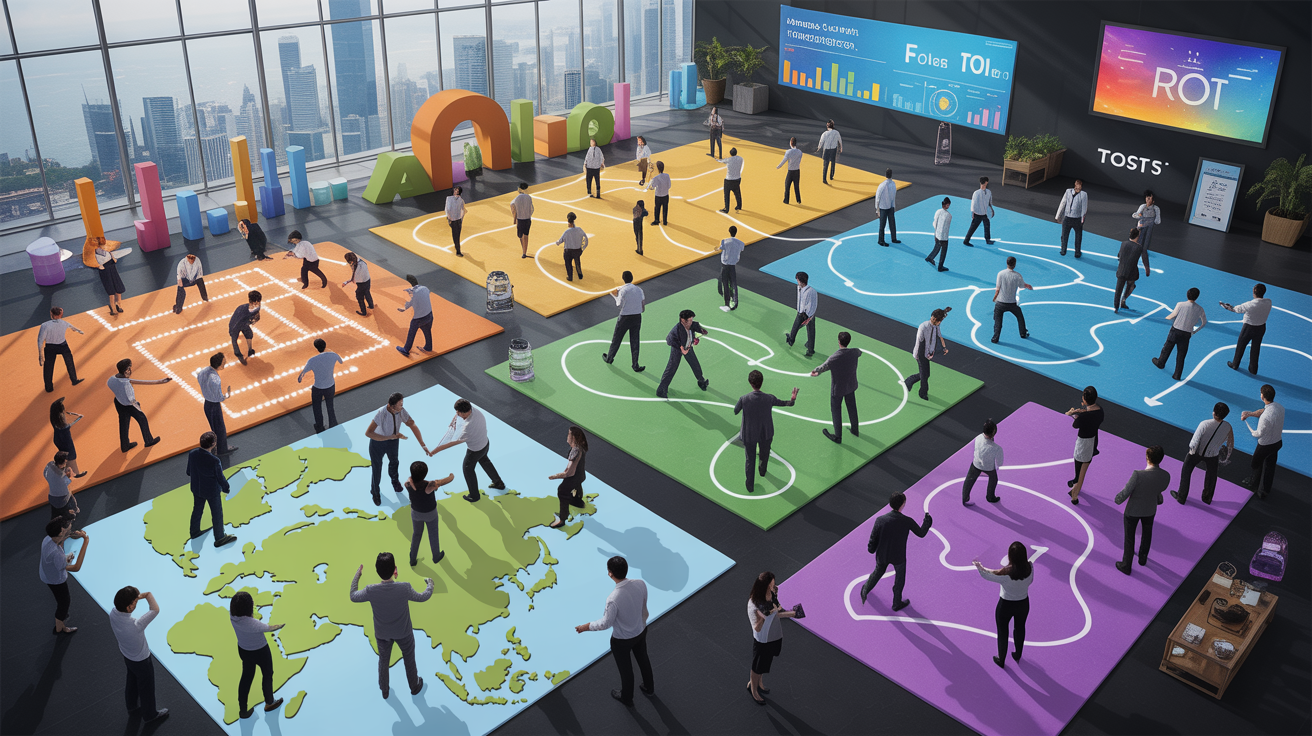
Multiple activity zones: The best large-group team experiences often incorporate “stations” or zones where different activities occur simultaneously. Look for venues with flexible layouts that allow for both whole-group gatherings and breakout activities.

Traffic flow: Visualize how 50+ people will move through the space during transitions between activities. Are hallways, doorways, and paths wide enough to prevent bottlenecks? Is there clear space for queuing if necessary?

Restroom capacity: Often overlooked but critically important—ensure the venue has sufficient facilities to handle peak usage during breaks without creating long waiting lines that eat into activity time.

Temperature control: Large groups generate significant body heat, especially during active games. Venues with inadequate climate control can quickly become uncomfortably warm, undermining the experience.

Time Management

Time expands with group size. Activities that take 30 minutes with 20 participants might require 45-60 minutes with 50+ due to the additional time needed for instructions, transitions, and ensuring everyone completes each phase. When building your schedule:

Buffer generously: Add 25-30% more time to each activity segment than you think necessary, especially for transitions between activities.

Stagger breaks: Consider releasing participants for breaks in waves to prevent overwhelming restroom facilities and refreshment stations.

Pre-set materials: Distributing materials to large groups consumes valuable time. Have all materials pre-positioned at tables or stations whenever possible.

Visual timekeeping: Use projected countdown timers visible to all participants during activities to keep energy high and activities moving forward.

Facilitator-to-Participant Ratios

Appropriate staffing makes or breaks large-group experiences. At Trost Learning, we’ve found these ratios effective for different team-building formats:

Single large-group format: For activities where all participants engage in the same experience simultaneously, maintain a ratio of 1 lead facilitator plus 1 support facilitator for every 25 participants. This ensures instructions are clear, questions are answered promptly, and facilitators can observe and intervene as needed.

Rotational station format: When using activity stations that teams rotate through, assign one dedicated facilitator per station plus floating facilitators to manage transitions (typically 1 floater per 50 participants).

Breakout team format: If your design incorporates breakout teams working on separate challenges, assign 1 facilitator for every 3-4 teams to provide guidance and keep teams on track.

Beyond professional facilitators, consider recruiting and briefing volunteers from within the organization to serve as team captains or station assistants, extending your facilitation reach.

Equipment & Materials Management

The logistics of providing materials for 50+ participants requires systems thinking. Consider these approaches:

Kit preparation: Pre-package materials into team kits that can be quickly distributed rather than handing out individual items.

Simplified materials: Where possible, design activities that require fewer physical materials without sacrificing engagement.

Digital alternatives: Consider replacing physical handouts with QR codes linking to digital resources, reducing distribution complexity.

Inventory management: Develop clear systems for tracking and collecting materials post-activity, especially for reusable items.

Selecting Appropriate Games for Large Groups

Not all team-building activities scale effectively. Games that create magical experiences for 15-20 participants can become logistical nightmares or provide minimal engagement when applied to groups of 50+. Here’s how to select activities that deliver impact at scale:

Highly Scalable Activities

The most effective large-group games share certain characteristics that enable them to maintain engagement regardless of participant numbers:

Simultaneous involvement: Activities where all participants can be actively engaged at once rather than taking turns maintain energy and prevent disengagement. Examples include:

Collaborative Art Installations: Teams work on separate components that ultimately combine into a larger organizational mural or structure, creating both team focus and whole-group impact.

Rhythm-Based Activities: Synchronized drumming or movement activities create powerful shared experiences where everyone contributes simultaneously to a collective outcome.

Mass Problem-Solving Challenges: Specially designed puzzles or challenges where teams work in parallel before combining their solutions into a whole-group resolution.

Modular Game Structures

Modular activities use a “small within large” approach, breaking the larger group into manageable teams while maintaining a cohesive overall experience:

Tournament Structures: Teams compete in rounds, with winners advancing through brackets. This creates focused small-group engagement while maintaining whole-group interest in the tournament progression.

Puzzle Piece Design: Each team works on one element of a larger challenge, requiring cross-team coordination to achieve the final objective. This approach teaches both team excellence and inter-team collaboration.

Rotation Systems: Teams cycle through different activity stations, each offering a unique challenge related to an overall theme. This approach maintains small-group intimacy while providing variety and movement.

Technology-Enhanced Solutions

Digital platforms can significantly enhance large-group experiences by solving common logistical challenges:

Mobile Team Challenges: App-based team challenges allow participants to receive instructions, submit responses, and track progress digitally, eliminating the need for paper materials and reducing facilitator burden.

Real-Time Response Systems: Digital polling and response platforms enable instant collection of insights or answers from all participants, creating dynamic interaction even with very large groups.

Virtual Integration: For hybrid events or very large groups, strategic use of virtual elements can extend participation beyond physical constraints.

At Trost Play, we’ve developed S.M.A.R.T Play Experiences that strategically incorporate technology to enhance rather than replace human connection, ensuring digital elements serve the learning objectives rather than becoming mere novelties.

Measuring ROI in Large-Group Team Building

Justifying the significant investment required for large-group team building demands rigorous ROI measurement. Unlike smaller team activities, which might be justified on general team health grounds, large-scale events typically require demonstrable business impact.

Key Performance Metrics

Effective ROI measurement begins with selecting the right metrics aligned with your specific objectives. Common metrics include:

Immediate Experience Metrics:

• Participant satisfaction and engagement scores

• Quality and quantity of cross-departmental connections formed

• Reported clarity on organizational priorities or values

Intermediate Outcome Metrics:

• Improvements in cross-functional collaboration frequency

• Reduction in silo mentality (measured through surveys)

• Increased knowledge sharing across departments

• Enhanced understanding of other functions’ challenges and priorities

Business Impact Metrics:

• Reduction in project completion times requiring cross-functional work

• Employee retention improvements

• Innovation metrics (number of new ideas, implementation rates)

• Customer experience improvements from better internal collaboration

Data Collection Methods

Gathering meaningful data from large groups requires efficient, multi-phase approaches:

Pre-Event Baseline: Conduct brief surveys or assessments before the event to establish baseline measures on key metrics, particularly those related to cross-functional collaboration and organizational alignment.

In-Event Capture: Use digital tools to gather real-time feedback during the event, including immediate reflection questions after key activities. This data captures learning moments while they’re fresh.

Post-Event Evaluation: Deploy a comprehensive evaluation within 48 hours of the event to measure immediate impact and experience quality. Include questions about specific learnings and intended behavior changes.

Follow-Up Measurement: Conduct follow-up assessment 30, 60, or 90 days post-event to measure sustained behavior change and business impact. These follow-ups are critical for demonstrating lasting ROI.

ROI Analysis Framework

Translating data into ROI requires a structured analysis approach:

1. Direct Cost Calculation: Include all direct expenses (venue, facilitators, materials, technology, catering, transportation).

2. Opportunity Cost Assessment: Calculate the value of participant time based on average hourly costs and hours invested.

3. Benefit Quantification: Convert improvements in key metrics to financial terms where possible:

• Value productivity gains from improved collaboration

• Calculate cost savings from reduced turnover

• Estimate revenue impact from innovation or process improvements

4. ROI Calculation: Use the standard ROI formula:

ROI (%) = [(Benefits – Costs) / Costs] × 100

5. Intangible Benefit Documentation: Supplement quantitative ROI with qualitative benefits that resist direct financial valuation but deliver organizational value:

• Cultural alignment stories

• Leadership development observations

• Cross-functional relationship formation

Through Emergenetics Profiling and assessment, organizations can gain deeper insights into how team-building activities impact thinking preferences and behavioral attributes, providing an additional dimension to ROI measurement.

Case Studies: Successful Large-Group Implementations

Financial Services Organization: Uniting Through Change

A leading financial institution faced the challenge of integrating two distinct organizational cultures following a merger. With 200+ employees spanning different functional areas, they needed an intervention that would break down cultural barriers and create shared identity.

Trost Learning designed a full-day experience using modular team challenges structured around the organization’s new values. Participants worked in cross-functional teams of 8-10, with each team completing challenges at different stations throughout the day. The design incorporated:

• Pre-assigned diverse teams with members from both original organizations

• Activities specifically designed to highlight complementary strengths

• Technology-enabled reflection points where insights were captured in real-time

• A dramatic final activity that physically brought all 200+ participants together in a collaborative challenge

Results: Post-event surveys showed a 47% increase in cross-legacy collaboration intentions. Six-month follow-up data revealed that 68% of participants had formed lasting working relationships with colleagues from the other legacy organization. Project teams with members from both legacy organizations completed integration projects 23% faster than those with single-legacy composition.

Technology Company: Innovation Acceleration

A tech company with 150 employees across product development, engineering, marketing, and customer support teams needed to break down silos impeding their innovation pipeline. Their specific challenge was that ideas generated in one department rarely incorporated insights from other functional areas, leading to implementation problems.

We developed a custom game-based experience that:

• Utilized Emergenetics Profiling to create cognitively diverse teams

• Incorporated competitive “innovation sprints” where teams developed solutions to real company challenges

• Used digital platforms for teams to share and build upon each other’s ideas

• Culminated in a company-wide innovation showcase with leadership feedback

Results: The event generated 27 viable product or process improvement ideas, 12 of which were implemented within six months. Cross-functional ideation sessions increased by 64% in the quarter following the event, and the company reported a 31% reduction in implementation obstacles for new initiatives. The estimated first-year value of implemented innovations exceeded the program investment by 8.5×.

Conclusion

Game-based team building for large groups represents one of the most powerful interventions available to organizations seeking to transform culture, break down silos, and build collaborative capacity at scale. When thoughtfully designed and expertly facilitated, these experiences create shared reference points and connections that continue generating value long after the event concludes.

However, this power comes with corresponding complexity. The logistical demands, facilitation requirements, and design considerations for large-group experiences are substantially different from smaller team interventions. Success depends on meticulous planning, appropriate game selection, adequate facilitation resources, and robust measurement approaches.

By approaching large-group team building with the frameworks outlined in this guide—from venue selection to ROI analysis—organizations can create transformative experiences that justify their investment many times over. The key lies in treating these events not as isolated fun activities but as strategic interventions designed with clear business outcomes in mind.

For organizations serious about breaking down silos, building collaborative culture, or navigating significant change, well-designed large-group experiences aren’t merely nice-to-have events but essential strategic tools for organizational development and alignment.

At Trost Learning, our extensive experience designing and implementing team-building experiences for groups ranging from 50 to 500+ participants across Asia Pacific has confirmed repeatedly that scale need not come at the expense of impact. Through thoughtful design, appropriate technology integration, and expert facilitation, large-group experiences can deliver transformative outcomes and measurable returns.

Whether your organization needs to unite following restructuring, accelerate innovation through cross-functional collaboration, or simply strengthen the human connections that drive engagement and retention, large-scale game-based team building offers a powerful intervention. The key lies in approaching these events with strategic intent, design expertise, and measurement discipline.

The most successful organizations today recognize that collaboration at scale isn’t merely a cultural nicety but a business imperative. By investing in expertly designed large-group experiences, these organizations build the collaborative infrastructure needed to navigate complexity and change in today’s business environment.

Ready to explore how purpose-driven, game-based team building can transform collaboration and alignment for your large group? Contact Trost Learning today to discuss your objectives and discover how our award-winning approach to learning experience design can deliver measurable results for your organization.

Contact Our Team

15 Budget-Friendly Team-Building Ideas for Singapore SMEs That Deliver Real Results

Post

Table Of Contents

  1. Introduction
  2. Why Team Building Matters for Singapore SMEs
  3. 5 Indoor Low-Cost Team-Building Activities
  4. 5 Outdoor Budget-Friendly Team-Building Ideas
  5. 5 Virtual Team-Building Activities for Remote Teams
  6. Measuring the Success of Your Team-Building Efforts
  7. Leveraging Emergenetics Profiling for Enhanced Team Building
  8. Conclusion

15 Budget-Friendly Team-Building Ideas for Singapore SMEs That Deliver Real Results

In Singapore’s dynamic business landscape, small and medium enterprises (SMEs) face unique challenges in building cohesive, high-performing teams without straining limited resources. Team building doesn’t need expensive retreats or elaborate activities to be effective. In fact, some of the most impactful team-building experiences come from thoughtfully designed, low-cost activities that address specific team needs.

At Trost Learning, we’ve witnessed firsthand how purposeful team-building transforms workplace dynamics across our 800+ programmes delivered to over 25,000 participants. This article presents 15 budget-friendly team-building ideas specifically tailored for Singapore SMEs, organized by environment (indoor, outdoor, and virtual) to suit your team’s preferences and work arrangements. We’ll also explore how to measure the impact of these activities and how tools like Emergenetics Profiling can maximize your team-building effectiveness.

Whether you’re looking to improve communication, boost morale, or simply foster stronger bonds among team members, these accessible activities will help you build a more connected, engaged workforce without breaking the bank.

‘); opacity: 0.4;”>

15 Budget-Friendly Team-Building Ideas for Singapore SMEs

Strengthen relationships and boost productivity without breaking the bank

Why Team Building Matters

  • 67% of Singapore SMEs face talent retention & team cohesion challenges
  • Effective team building creates psychological safety and improves communication
  • Regular activities reinforce company values and reveal hidden talents

Indoor Ideas

  • 1.DIY Escape Room ($50-100)
  • 2.Skill Exchange Workshop ($0-30)
  • 3.Office Olympics ($20-50)
  • 4.Blind Drawing Challenge ($0-10)
  • 5.DIY Innovation Challenge ($20-100)

Outdoor Ideas

  • 1.Amazing Race Singapore ($30-60)
  • 2.Community Service ($0-50)
  • 3.Park Circuit Training ($0-30)
  • 4.Photography Challenge ($0-20)
  • 5.Collaborative Picnic ($5-10 pp)

Virtual Ideas

  • 1.Virtual Escape Room ($15-25 pp)
  • 2.Remote Team Trivia ($0-10)
  • 3.Virtual Coffee Roulette ($0-10)
  • 4.Collaborative Playlist ($0)
  • 5.Remote Work Hackathon ($0-50)

Measuring Success

1

Employee Engagement

Use pulse surveys to track changes

2

Communication Effectiveness

Monitor meeting efficiency & response times

3

Conflict Resolution

Track how quickly conflicts are resolved

4

Innovation Metrics

Note increases in idea sharing

Enhance Team Building with Emergenetics Profiling

  • Improve communication based on thinking preferences
  • More effective conflict resolution
  • Enhance problem-solving with cognitive diversity
  • Maximize impact of every team-building dollar

Ready to take your team building to the next level?

Trost Learning specializes in creating customized, impactful team development experiences for Singapore SMEs.

Contact Us Today

Why Team Building Matters for Singapore SMEs

For Singapore-based SMEs operating in one of Asia’s most competitive business environments, effective team building is not just a nice-to-have—it’s essential for survival and growth. Limited resources mean each team member often wears multiple hats, making strong interpersonal relationships and seamless collaboration critical success factors.

According to a 2022 Singapore Business Federation survey, 67% of local SMEs identified talent retention and team cohesion as significant challenges. Regular team-building activities address these concerns by creating psychological safety, improving communication, and increasing employee satisfaction—all factors that contribute to lower turnover rates and higher productivity.

The benefits of consistent team building for Singapore SMEs include:

  • Breaking down communication silos between departments
  • Building trust in multicultural work environments
  • Revealing hidden talents and strengths within your team
  • Creating shared experiences that reinforce company values
  • Improving problem-solving abilities through collaborative challenges

The most successful SMEs approach team building as a strategic investment rather than an occasional recreational activity. The key is selecting activities that align with specific business goals while respecting cultural sensitivities prevalent in Singapore’s diverse workforce.

5 Indoor Low-Cost Team-Building Activities

Indoor team-building activities offer climate-controlled comfort (essential in Singapore’s heat and unexpected downpours) while requiring minimal resources. Here are five effective options that can be implemented in your office space or an affordable rented venue:

1. Problem-Solving Escape Room

Create a DIY escape room experience by setting up puzzles and challenges around your office. Teams must solve problems collectively to “escape” within a set timeframe. This activity develops critical thinking, communication, and collaboration under pressure.

Cost: $50-100 for puzzle materials and props

Implementation tip: Design puzzles that require diverse thinking styles. Some challenges should appeal to analytical minds, while others might need creative approaches or interpersonal skills—this creates natural opportunities for different team members to lead.

2. Skill Exchange Workshop

Leverage the diverse expertise within your team by organizing a skill exchange workshop where team members teach each other valuable skills. From basic coding to effective presentation techniques or even cooking a signature dish, these workshops highlight individual strengths while providing practical value to the entire team.

Cost: $0-30 for basic materials

Implementation tip: Schedule 30-minute sessions during lunch breaks or dedicate an afternoon to multiple mini-workshops. Create a skills inventory beforehand to identify teaching opportunities that align with business needs.

3. Office Olympics

Transform ordinary office supplies into competition tools for an Office Olympics event. Paper airplane distance contests, chair races, rubber band archery, and paperclip chains can become surprisingly engaging competitions when teams are competing for bragging rights (and perhaps small prizes).

Cost: $20-50 for prizes and materials

Implementation tip: Design inclusive games that don’t rely solely on physical ability. Mix individual and team events to build both personal confidence and group cohesion. Consider incorporating company trivia into the competitions.

4. Blind Drawing Communication Challenge

In this activity focusing on clear communication, team members pair up with one person describing an image while the other attempts to draw it without seeing the original. The resulting comparisons often yield both laughter and valuable insights about communication effectiveness.

Cost: $0-10 for paper and drawing supplies

Implementation tip: After the activity, facilitate a discussion about communication challenges that arose and how these same patterns might appear in day-to-day work interactions. This reflection transforms a simple activity into meaningful learning.

5. DIY Innovation Challenge

Provide teams with a limited budget (e.g., $20) and challenge them to create a product or service that solves a specific business problem or customer need. Teams present their innovations to a panel of “investors” (company leaders) who provide feedback and select winners based on creativity, feasibility, and potential impact.

Cost: $20-100 depending on team size and materials provided

Implementation tip: Choose challenge themes relevant to your business goals or current projects. This turns team building into practical innovation that might generate valuable ideas for the company.

5 Outdoor Budget-Friendly Team-Building Ideas

Singapore offers numerous free or low-cost outdoor venues perfect for team building. These activities take advantage of the city’s unique geography while providing a refreshing change from the office environment.

1. Amazing Race Singapore Edition

Create your own Amazing Race across accessible public areas in Singapore. Teams follow clues, complete challenges, and take photos at landmarks while racing against the clock. This activity builds problem-solving skills while exploring Singapore’s cultural heritage.

Cost: $30-60 for clue materials and small prizes

Implementation tip: Incorporate MRT and public transport to keep costs down while making the race more accessible. Include challenges that require interaction with local culture, such as ordering specific hawker center dishes or learning a phrase in different languages spoken in Singapore.

2. Community Service Project

Partner with local organizations for a half-day community service project. Options include beach cleanups at East Coast Park, volunteering at food banks, or participating in community garden initiatives. Service projects build team unity while reinforcing social responsibility.

Cost: $0-50 for transportation and basic supplies

Implementation tip: Connect the service activity to your company’s values or CSR objectives. Allocate time afterward for reflection on the experience and how it relates to workplace collaboration.

3. Park Circuit Training

Utilize Singapore’s public parks for a team fitness circuit that combines exercise with team challenges. Stations can include both physical activities and mental puzzles that must be completed collaboratively. This promotes wellness alongside teamwork.

Cost: $0-30 for activity materials

Implementation tip: Design options for different fitness levels to ensure inclusivity. Frame the activity around health and wellness rather than competition, and consider incorporating team goals rather than individual performance metrics.

4. Photography Challenge

Teams receive a list of conceptual prompts (e.g., “collaboration,” “innovation,” “resilience”) and must capture creative photographs representing each concept using just smartphone cameras. This activity encourages creative thinking and diverse perspectives.

Cost: $0-20 for printing winning photos

Implementation tip: Choose locations like Botanic Gardens, Gardens by the Bay (public areas), or Marina Bay that offer diverse backdrops without entrance fees. Display the best photos in your office afterward as visual reminders of team creativity.

5. Collaborative Picnic Challenge

Assign each team member responsibility for bringing one component of a shared meal without revealing what others are bringing. The team must then work together to create a cohesive meal from the random assortment. This fun activity demonstrates adaptation, resource management, and creativity.

Cost: $5-10 per person for food contributions

Implementation tip: Host this at accessible public parks with picnic facilities like East Coast Park or West Coast Park. Establish some basic parameters (e.g., one person brings a main dish, another dessert) to prevent complete chaos while still maintaining the challenge element.

5 Virtual Team-Building Activities for Remote Teams

With hybrid and remote work becoming common among Singapore SMEs, virtual team-building activities are essential for maintaining connection across physical distances. These digital experiences can be just as engaging as in-person events when thoughtfully designed.

1. Virtual Escape Room

Online escape rooms provide interactive problem-solving experiences that require teamwork to complete. Many affordable options specifically designed for work teams are available, with puzzles that can only be solved through collaboration.

Cost: $15-25 per person

Implementation tip: Choose escape rooms with Singapore themes or contexts when available for added relevance. Ensure teams are small enough (4-6 people) that everyone can actively participate rather than having some members disengage.

2. Remote Team Trivia

Create a custom trivia game incorporating questions about your company, industry knowledge, and team members’ hidden talents or experiences. This builds camaraderie while reinforcing organizational knowledge.

Cost: $0-10 for digital prize vouchers

Implementation tip: Use free platforms like Kahoot or Mentimeter to create interactive quizzes. Include a mix of business-relevant questions and personal interest questions to balance learning with relationship building.

3. Virtual Coffee Roulette

Randomly pair team members for 15-minute virtual coffee chats on a regular basis (weekly or bi-weekly). This creates cross-departmental connections and combats the isolation that can occur in remote work environments.

Cost: $0 (or consider sending small coffee shop vouchers for $5-10 per person)

Implementation tip: Provide conversation prompts that go beyond small talk to help team members discover meaningful connections. Track pairings to ensure everyone connects with different colleagues over time.

4. Collaborative Playlist Creation

Task your team with building a shared workspace playlist where each person contributes songs that motivate them or represent their personality. This creates a collective resource while sparking conversations about musical preferences and work styles.

Cost: $0 using free streaming platforms

Implementation tip: Host a virtual listening party where team members introduce their song selections and explain their significance. This transforms a simple playlist into meaningful personal sharing.

5. Remote Work Hackathon

Challenge teams to develop solutions for common remote work pain points in a time-limited virtual hackathon. Teams research, design, and pitch their ideas through collaborative online tools, building problem-solving skills while improving their own work environment.

Cost: $0-50 for implementation resources for winning ideas

Implementation tip: Focus on realistic challenges that your organization actually faces, such as improving remote communication or maintaining company culture across distance. Commit to implementing (or at least testing) the best ideas to demonstrate that team input is valued.

Measuring the Success of Your Team-Building Efforts

Effective team building should deliver measurable business value. To ensure your investment of time and resources yields meaningful results, establish metrics to track progress before and after team-building initiatives.

Consider measuring:

  1. Employee engagement scores – Use brief pulse surveys before and after activities to gauge changes in team satisfaction and connection.
  2. Communication effectiveness – Track metrics like meeting efficiency, email response times, or project collaboration tool usage.
  3. Conflict resolution – Monitor how quickly and effectively team disagreements are addressed and resolved.
  4. Innovation metrics – Note increases in idea sharing or improvements to processes following team activities.
  5. Retention improvements – Compare turnover rates before and after implementing regular team building.

The most valuable measurement approach combines quantitative data with qualitative feedback. Create opportunities for team members to share specific examples of how team building has impacted their work experience, then use these insights to refine your approach.

Leveraging Emergenetics Profiling for Enhanced Team Building

While the activities described above provide excellent starting points, their effectiveness multiplies when built upon a foundation of self-awareness and interpersonal understanding. This is where Emergenetics Workshop & Programmes create exceptional value for Singapore SMEs.

Emergenetics Profiling provides scientific insights into thinking preferences and behavioral attributes that influence how team members communicate, solve problems, and collaborate. Unlike one-size-fits-all team building, Emergenetics-informed activities can be tailored to address specific team dynamics and development needs.

Key benefits of incorporating Emergenetics Profiling into your team-building strategy include:

  • Improved communication based on understanding different thinking preferences
  • More effective conflict resolution by recognizing the root causes of disagreements
  • Enhanced problem-solving by intentionally leveraging cognitive diversity
  • Increased empathy and appreciation for different working styles
  • More targeted team development based on your team’s specific profile composition

Singapore SMEs with limited development budgets find particular value in Emergenetics Profiling because it maximizes the impact of every team-building dollar by addressing root causes rather than symptoms of team dysfunction.

Through our Corporate and Personal Development Programmes, we’ve helped countless Singapore organizations transform simple team activities into powerful development experiences by integrating Emergenetics principles into their design and facilitation.

Conclusion

Building strong, cohesive teams doesn’t require lavish budgets—it requires thoughtful design, consistent implementation, and a clear connection to business objectives. The 15 low-cost team-building activities outlined in this article offer Singapore SMEs practical starting points for enhancing team performance while respecting financial constraints.

Remember that the most effective team building isn’t a one-time event but an ongoing commitment to developing your people and their relationships. By integrating regular team experiences into your organizational rhythm and measuring their impact, you can create a workplace culture where collaboration thrives and team members feel genuinely connected to each other and your company’s mission.

For teams seeking deeper transformation, tools like Emergenetics Profiling provide scientific insights that can elevate simple activities into powerful development experiences. Whether you’re just beginning your team-building journey or looking to enhance existing initiatives, the key is starting with clear objectives and choosing activities that align with your team’s unique needs and your organization’s strategic goals.

At Trost Learning, we believe that purposeful play creates transformative learning. Through our S.M.A.R.T Play Experiences, we help Singapore organizations design team interactions that are both enjoyable and impactful—creating stronger teams that drive business success.

Ready to take your team building to the next level? Trost Learning specializes in creating customized, impactful team development experiences for Singapore SMEs. From Emergenetics Profiling to tailored workshop design, our expert facilitators can help you maximize the effectiveness of your team-building investments. Contact us today to discuss how we can support your team’s growth and performance.

Remote-Friendly Team-Building Ideas: 12 Virtual Formats That Truly Engage Distributed Teams

Post

The shift to remote and hybrid work environments has fundamentally changed how teams connect, collaborate, and build relationships. While physical distance creates obvious barriers to traditional team bonding, it also opens up new possibilities for innovative engagement approaches that transcend geographical limitations. As organisations continue to navigate this evolving landscape, the need for purpose-driven, effective virtual team-building has never been more critical.

At Trost Learning, we’ve observed firsthand how thoughtful remote team-building initiatives can transform disconnected groups into cohesive, high-performing teams. Since 2015, we’ve helped over 200 organisations across Asia Pacific develop stronger teams through intentional connection strategies—even when team members are thousands of kilometres apart.

This comprehensive guide explores 12 virtual team-building formats that genuinely engage remote teams. Rather than superficial activities that feel like obligatory additions to already-packed calendars, these approaches are designed to create meaningful connections while simultaneously developing skills that enhance workplace effectiveness. From structured learning experiences to playful interaction opportunities, each format can be tailored to your team’s specific needs, preferences, and organisational culture.

12 Virtual Team-Building Formats

That Truly Engage Remote Teams

Transform disconnected remote groups into cohesive, high-performing teams with these effective virtual team-building strategies.

Remote Work Challenges

Screen Fatigue

Additional screen time can feel overwhelming rather than energizing.

Time Zone Differences

Scheduling challenges for globally distributed teams require creative solutions.

Technology Barriers

Varying access and comfort levels with digital platforms can create obstacles.

Cultural Differences

Limited contextual cues can amplify cultural differences in virtual environments.

Effective Virtual Team-Building Formats

1

Virtual Team Challenges

Collaborative problem-solving activities that simulate real workplace scenarios.

2

Online Escape Rooms

Immersive adventures requiring diverse thinking and effective communication.

3

Virtual Coffee Chats

Structured conversations that create safe spaces for relationship-building.

4

Digital Campfire Sessions

Storytelling formats that build understanding and empathy among team members.

5

Emergenetics Profiling

Workshops that develop understanding of thinking preferences and communication styles.

6

Virtual Team Trivia

Customized competition blending general knowledge with company-specific content.

7

Remote Lunch and Learns

Professional development combined with social connection during informal meal times.

8

Online Games with Purpose

Strategic game selection that develops workplace skills while creating enjoyable experiences.

9

Virtual Team Hackathons

Condensed innovation sessions tackling organizational challenges through collaboration.

10

Remote Wellness Challenges

Shared initiatives addressing physical and mental health while building community.

11

Digital Skill Shares

Micro-teaching sessions leveraging team members’ diverse expertise and creating learning relationships.

12

Virtual Recognition Ceremonies

Structured appreciation practices that combat the recognition deficit in remote environments.

Implementation Best Practices

Create Intentional Cadence

Regular, predictable connection opportunities signal organizational commitment to team cohesion.

Balance Synchronous & Asynchronous

Accommodate different time zones with flexible formats and participation options.

Involve Team Members in Design

Different teams have different connection needs. Involve members in activity selection.

Build Reflection Into Every Activity

Guided reflection increases the transfer of insights to everyday work contexts.

Why Remote Team-Building Matters

Remote work offers numerous advantages, from flexibility and reduced commute times to access to global talent. However, it also presents unique challenges for team cohesion. Without shared physical spaces and spontaneous interactions, remote teams can struggle with:

Building trust and psychological safety becomes more challenging when team members have limited visibility into each other’s work styles, personalities, and daily challenges. This trust deficit can manifest in miscommunication, reduced collaboration, and diminished problem-solving capacity.

Furthermore, remote environments can amplify feelings of isolation. A 2021 study by Buffer found that 16% of remote workers cite loneliness as their biggest struggle—a percentage that increases among fully distributed teams. This isolation not only affects individual wellbeing but can significantly impact team performance and retention rates.

Effective virtual team-building addresses these challenges by creating structured opportunities for connection that develop stronger interpersonal bonds while reinforcing organizational values and goals. Rather than viewing team-building as a separate activity from “real work,” the most successful organizations integrate relationship-building into their operational rhythms.

Challenges of Virtual Team-Building

Before exploring specific formats, it’s important to acknowledge the obstacles that make virtual team-building uniquely challenging:

Screen fatigue represents perhaps the most significant barrier. After days filled with video meetings, the prospect of additional screen time—even for team bonding—can feel overwhelming rather than energizing. Effective virtual team-building must address this reality through thoughtful timing, duration, and engagement techniques.

Time zone differences present logistical challenges for globally distributed teams. Activities requiring synchronous participation must consider when team members are reasonably available, which often requires creative scheduling or rotating time slots to ensure equitable participation opportunities.

Technology access and comfort levels vary significantly across teams. While some team members may have high-speed connections and comfort with various digital platforms, others may struggle with technical limitations or anxiety about navigating new tools. Successful virtual team-building accounts for these differences with accessible formats and clear instructions.

Cultural differences, while always present in diverse teams, can become more pronounced in virtual environments where contextual cues are limited. Activities must be designed with cultural sensitivity and inclusivity in mind, avoiding assumptions about shared references or interaction preferences.

12 Virtual Team-Building Formats That Engage

The following formats have been selected based on their demonstrated effectiveness in creating meaningful connections among remote teams. Each can be adapted to different team sizes, cultures, and objectives.

1. Virtual Team Challenges

Structured challenges that require collaborative problem-solving create natural opportunities for teams to leverage their diverse thinking styles and skills. These activities simulate real workplace challenges while fostering cooperation in a low-stakes environment.

For example, a “virtual bridge-building challenge” might task teams with designing and presenting a solution using only materials team members have in their home offices. This requires creative thinking, communication across distance, and presentation skills—all valuable workplace competencies.

The key to effective virtual challenges is establishing clear parameters, timeframes, and desired outcomes while leaving room for creative approaches. The debrief following these activities is crucial, helping teams translate insights about their collaboration processes to everyday work scenarios.

2. Online Escape Rooms

Digital escape rooms have evolved significantly, offering immersive experiences that require diverse thinking styles and effective communication. These structured adventures place teams in scenarios where they must collectively solve puzzles, find clues, and complete objectives within a time limit.

The time-bound nature of escape rooms creates healthy pressure that reveals natural team dynamics around leadership, communication, and problem-solving approaches. Teams must quickly determine how to divide tasks, share information effectively, and integrate diverse perspectives—mirroring the challenges of complex workplace projects.

Many professional platforms now offer custom virtual escape rooms that can incorporate company values, industry challenges, or specific learning objectives. When facilitated effectively, the post-activity reflection becomes as valuable as the experience itself, helping teams identify communication patterns and collaboration opportunities.

3. Virtual Coffee Chats

While seemingly simple, structured virtual coffee sessions create safe spaces for relationship-building that might otherwise not occur in remote environments. The key differentiation between effective coffee chats and awkward small talk lies in thoughtful facilitation and purpose.

Random pairings or small groups (2-3 people) meet for 20-30 minutes with light structure provided through conversation prompts or themes. These prompts should balance personal sharing with professional relevance—for example, “Share a challenge you’ve overcome recently and what it taught you” or “Describe a non-work skill that surprisingly helps in your professional role.”

For maximum impact, these sessions should occur regularly (biweekly or monthly) with rotating pairings, creating a network effect as team members connect across traditional departmental or hierarchical boundaries. Leadership participation signals organizational value for relationship-building and creates opportunities for informal mentorship.

4. Digital Campfire Sessions

Storytelling represents one of humanity’s most fundamental connection tools, and digital campfire sessions leverage this power in virtual environments. These sessions create space for team members to share experiences, perspectives, and narratives in a structured format that builds understanding and empathy.

A typical digital campfire session involves 5-8 participants and a facilitator who introduces a theme or prompt. Each person shares a brief story (3-5 minutes) related to the theme, followed by appreciative questions from colleagues. Themes might include “a moment that shaped my professional journey,” “a time I failed and what it taught me,” or “an unexpected mentor in my life.”

These sessions work best when established as a regular practice with clear parameters around confidentiality and psychological safety. The facilitator plays a crucial role in modeling vulnerable sharing, managing time, and guiding supportive responses. Over time, these storytelling practices create shared narratives that strengthen team identity and trust.

5. Emergenetics Profiling Workshops

Understanding thinking preferences and behavioral attributes becomes even more crucial when teams work remotely without the benefit of daily observation and interaction. Emergenetics Profiling provides teams with a common language to understand cognitive diversity and communication preferences.

Virtual Emergenetics workshops begin with individual assessments that identify thinking and behavioral preferences across seven distinct attributes. The interactive workshop session then helps team members understand not only their own profiles but how different thinking styles manifest in virtual collaboration scenarios.

The practical application phase is where remote teams experience the most value—learning to recognize how thinking preferences influence virtual meeting participation, project approach preferences, and communication needs. Teams develop strategies for leveraging their collective cognitive diversity while respecting individual work styles. This shared understanding creates a foundation for more effective collaboration, reducing friction points common in remote work.

6. Virtual Team Trivia

Friendly competition through customized trivia creates engagement while revealing knowledge areas and interests across the team. The most effective virtual trivia formats blend general knowledge questions with company-specific content and personal team facts.

Random team assignments for trivia competitions create cross-functional interaction opportunities, while themed rounds keep energy high and create natural conversation starters. Questions incorporating team member facts (“Which team member once lived in seven different countries?”) transform the game into a relationship-building exercise.

Tools like Kahoot, Quizizz, or custom Zoom polling features make implementation straightforward, while prizes (even symbolic ones) add excitement. For maximum engagement, consider having different team members host rounds based on their areas of expertise or interest, distributing the facilitation role.

7. Remote Lunch and Learns

Virtual lunch and learn sessions combine professional development with social connection, creating space for knowledge-sharing in a relaxed context. These optional sessions (typically 45-60 minutes) occur during lunch hours, with participants bringing their meals to create an informal atmosphere despite the virtual setting.

The most engaging lunch and learns tap into team member expertise rather than relying solely on external presenters. This approach validates internal knowledge while helping colleagues understand each other’s depth of experience. Topics might range from professional skills (“Design Thinking Basics”) to adjacent interests (“Photography Fundamentals”) or wellness practices (“Mindfulness for Focus”).

To enhance the social element, consider providing meal delivery vouchers occasionally, creating a shared experience despite physical distance. Building in 10-15 minutes of unstructured conversation before or after the content portion honors the relationship-building purpose alongside knowledge transfer.

8. Online Games with Purpose

Strategic game selection can develop specific team capabilities while creating enjoyable shared experiences. Unlike arbitrary online gaming, S.M.A.R.T Play Experiences utilize games intentionally chosen to develop relevant workplace skills.

For example, collaborative drawing games like Skribbl.io develop communication precision and interpretation skills—critical for remote teams who rely heavily on written communication. Strategy games like Codenames build critical thinking and understanding of colleagues’ thought processes. Simulation games develop resource allocation and decision-making skills under constraints.

The facilitation approach transforms simple games into learning experiences. Brief pre-game framing connects the activity to relevant workplace skills, while post-game debriefing helps participants extract insights about their collaboration patterns. This intentional approach distinguishes purposeful play from mere distraction.

9. Virtual Team Hackathons

Condensed innovation sessions focused on organizational challenges create natural collaboration opportunities while generating valuable outcomes. Virtual hackathons typically span 4-8 hours, with cross-functional teams tackling defined problems or opportunities relevant to the organization.

The time-bound, goal-oriented nature of hackathons creates productive pressure that accelerates relationship-building. Teams quickly establish roles, communication patterns, and decision-making approaches—revealing natural strengths and establishing trust through shared accomplishment.

Effective virtual hackathons require clear problem statements, diverse team composition, and structured facilitation to keep remote participants engaged. Digital collaboration tools (virtual whiteboards, document co-creation platforms) become essential infrastructure. The presentation of solutions creates visibility across the organization while celebrating team achievements.

10. Remote Wellness Challenges

Shared wellness initiatives address the physical and mental health challenges of remote work while creating supportive community. These team-based challenges establish collective goals around physical activity, mindfulness, sleep quality, or other wellbeing dimensions.

The most effective wellness challenges blend individual actions with team accountability and celebration. For example, a steps challenge might track both individual progress and team totals, with milestones unlocking company donations to charitable causes. Meditation challenges might include both personal practice and weekly group sessions.

Digital tracking platforms make progress visible, while regular check-ins create accountability without excessive pressure. The shared experience of working toward wellness goals creates natural conversation opportunities beyond work tasks, developing more holistic colleague relationships.

11. Digital Skill Shares

Micro-teaching sessions leverage team members’ diverse expertise while creating reciprocal learning relationships. In these brief (10-15 minute) sessions, individuals share specific skills, tools, or approaches from their professional or personal repertoire.

The democratic nature of skill shares—where everyone has something to teach and learn—creates mutual respect that strengthens team dynamics. Sessions might range from technical skills (“Excel formulas that save hours”) to productivity approaches (“My system for email management”) or creative techniques (“Basic principles of compelling visuals”).

Scheduling skill shares as brief segments within existing team meetings integrates learning into established rhythms rather than requiring additional time commitments. Recording and archiving sessions creates an expanding knowledge library that particularly benefits new team members.

12. Virtual Recognition Ceremonies

Structured appreciation practices combat the recognition deficit common in remote environments where achievements often lack visibility. Regular virtual ceremonies (monthly or quarterly) create space to acknowledge contributions, celebrate milestones, and reinforce team values.

Effective recognition ceremonies extend beyond work anniversaries and business outcomes to highlight collaboration behaviors, problem-solving approaches, and values demonstrations. Peer-to-peer recognition components ensure comprehensive visibility of contributions across hierarchical levels.

Creative delivery methods maintain engagement despite the virtual format—for example, digital award presentations, video compilations of team member testimonials, or surprise delivery of physical tokens synchronized with the virtual event. The ceremonial nature of these gatherings creates shared emotional experiences that strengthen team identity.

Measuring the Impact of Virtual Team-Building

While the relational benefits of team-building may seem intangible, effective measurement approaches can demonstrate concrete impact on organizational outcomes. Comprehensive assessment includes both immediate feedback and longitudinal tracking of team performance indicators.

Post-activity surveys should assess both enjoyment factors and perceived value dimensions, distinguishing between entertainment and meaningful connection. Simple pulse questions like “Did this experience help you understand colleagues better?” and “Will this change how you collaborate?” provide immediate insight.

For longer-term impact, incorporate team cohesion metrics into regular organizational assessments, looking for correlations between team-building participation and indicators like retention rates, collaboration effectiveness scores, and psychological safety measures. Narrative capture through team member stories often reveals impacts not visible in quantitative data alone.

Best Practices for Implementation

Successful virtual team-building requires intentional design and implementation. Consider these principles when adapting the formats above to your specific organizational context:

Create an intentional cadence rather than sporadic activities. Regular, predictable connection opportunities build momentum and signal organizational commitment to team cohesion. Integrate team-building into existing workflows and meeting structures where possible, rather than always requiring additional time commitments.

Balance synchronous and asynchronous components to accommodate different time zones and work patterns. Design experiences with flexibility—for example, a team challenge might have synchronous kickoff and closing sessions with asynchronous collaboration between. This approach respects individual schedules while maintaining collective momentum.

Involve team members in selection and design of activities rather than imposing standardized approaches. Different teams have different connection needs and preferences—what energizes one group might disengage another. Simple preference surveys or rotating responsibility for activity selection increases ownership and relevance.

Build reflection into every experience, regardless of format. The meaning derived from team activities emerges primarily through guided reflection rather than the activities themselves. Even brief structured debriefs significantly increase the transfer of insights to everyday work contexts.

Recognize that not every approach will resonate with every team member. Rather than seeking universal enthusiasm, aim for a portfolio of connection opportunities that collectively engage your full team through different modalities and interests. This variety ensures no team members feel consistently marginalized by the team-building approach.

Conclusion

Remote work continues to reshape organizational life, creating both challenges and opportunities for building cohesive, high-performing teams. The 12 virtual formats explored in this article move beyond superficial online socializing to create meaningful connections that enhance collaboration, communication, and commitment among distributed team members.

The most successful remote teams recognize that virtual team-building isn’t separate from “real work”—it’s an essential investment in the relational infrastructure that enables all other organizational functions. By intentionally creating spaces for connection, learning, and shared experience, leaders cultivate the trust and understanding that power innovation, resilience, and sustained performance.

As with any aspect of organizational culture, effective virtual team-building requires ongoing experimentation, feedback, and refinement. The formats presented here provide starting points rather than prescriptions—each should be adapted to your specific team composition, objectives, and cultural context.

By approaching virtual team-building with purpose and creativity, organizations can transform the constraints of physical distance into catalysts for more intentional, inclusive connection—developing teams that thrive regardless of their geographic distribution.

Ready to transform your remote team dynamics with purpose-driven engagement?

Trost Learning’s team of experienced facilitators specializes in designing customized virtual team-building experiences that create meaningful connections while developing essential workplace skills. From Emergenetics Profiling workshops to innovative S.M.A.R.T Play experiences, we help distributed teams build the collaborative capacity needed for sustainable success.

Contact Us to Discuss Your Team’s Needs

Path to Emergenetics Coaching Certification: Complete Guide to Requirements, Cost & ROI

Post

Table Of Contents

In today’s complex workplace, understanding what drives human behavior and communication has never been more valuable. Emergenetics stands apart as a transformative tool that illuminates cognitive and behavioral preferences in a way that’s both accessible and actionable. For coaches, HR professionals, and organizational leaders, becoming Emergenetics certified opens doors to enhanced team dynamics, improved communication, and measurable business outcomes.

While many understand the power of psychometric tools, the path to Emergenetics coaching certification remains unclear for many potential practitioners. What exactly does certification entail? What are the requirements? Is the investment—both in time and financial resources—truly worth it? And perhaps most importantly, what tangible return on investment can certified practitioners expect?

This comprehensive guide unpacks everything you need to know about becoming Emergenetics certified, from eligibility criteria and certification pathways to detailed cost breakdowns and ROI metrics. Whether you’re a corporate trainer, independent coach, or organizational leader looking to bring these powerful insights in-house, we’ll walk you through each step of the journey toward mastering this transformative framework.

Emergenetics Certification Journey

Your complete pathway to becoming an Emergenetics certified coach

What is Emergenetics?

7 Key Attributes

  • 4 Thinking Attributes: Analytical, Structural, Social, and Conceptual
  • 3 Behavioral Attributes: Expressiveness, Assertiveness, and Flexibility

Key Differentiators

  • Measures preferences on a spectrum
  • Recognizes strengths across all preferences
  • Combines genetics and experiences

Certification Requirements & Process

Prerequisites

  • Professional background in HR, Leadership, Coaching, or Training
  • Complete personal Emergenetics Profile
  • Experience as an Emergenetics workshop attendee

Certification Steps

  1. Application and approval (1-2 weeks)
  2. Pre-certification preparation (2-3 weeks)
  3. Core training (2-3 days in-person or 4-6 half-day virtual sessions)
  4. Post-training assessment and certification completion

Investment & ROI

Financial Investment

  • Core certification fee: $2,500-$4,000
  • Annual licensing: $500-$1,000 after first year
  • Additional costs: travel, profile credits

Time Investment

  • Pre-certification: 10-15 hours
  • Core training: 16-24 hours
  • Post-training practice: 5-10 hours

Measurable Business Outcomes

20-30%Improved Team Collaboration
30-40%Decrease in Team Conflicts
25-35%Increase in Innovation

Practical Applications

Team Development

Enhance collaboration and leverage cognitive diversity

Leadership Development

Enhance self-awareness and situational adaptability

Learning & Development

Design training engaging all thinking preferences

Next Steps to Certification

01Experience Emergenetics Firsthand
02Clarify Implementation Context
03Select Certification Pathway
04Prepare for Success

Start Your Certification Journey

Trost Learning

Your trusted partner for Emergenetics certification in Asia Pacific

Understanding Emergenetics: Foundation for Certification

Before diving into certification specifics, it’s essential to understand what makes Emergenetics distinctive in the landscape of psychometric assessments. Unlike personality typing systems that place individuals in rigid categories, Emergenetics measures preferences along a spectrum, acknowledging that human behavior is flexible and context-dependent.

Emergenetics is built on the concept that our thinking and behavioral preferences emerge from a combination of genetics and life experiences (hence the name “Emergenetics”). The assessment measures four Thinking Attributes (Analytical, Structural, Social, and Conceptual) and three Behavioral Attributes (Expressiveness, Assertiveness, and Flexibility).

What sets Emergenetics apart is its positive framework that recognizes strengths across all preferences rather than labeling certain traits as weaknesses. This appreciative approach makes it particularly effective in team settings where diversity of thought and behavior is crucial for innovation and problem-solving.

The foundation of effective Emergenetics coaching lies in not just understanding the framework intellectually, but in embodying its principles and applying them skillfully across various contexts. This is precisely what the certification process is designed to develop.

Emergenetics Certification Requirements: What You Need to Know

Becoming Emergenetics certified involves meeting specific prerequisites designed to ensure practitioners can effectively deliver the insights and applications that make this tool valuable. These requirements generally include:

Educational and Professional Background

While Emergenetics International doesn’t mandate specific degrees, certification candidates typically come from backgrounds in:

  • Human Resources or Talent Development
  • Organizational Development or Leadership
  • Professional Coaching or Consulting
  • Training and Facilitation
  • Education or Academic Administration

The ideal candidate brings experience in group facilitation, understands basic psychological concepts, and demonstrates the ability to translate abstract concepts into practical applications. Most importantly, candidates should show a genuine interest in helping individuals and teams leverage their cognitive diversity.

Pre-certification Experience

Before certification, candidates must:

  • Complete their own Emergenetics Profile to understand the assessment firsthand
  • Participate in an Emergenetics workshop as an attendee
  • Demonstrate familiarity with basic Emergenetics concepts and vocabulary

This experiential foundation ensures candidates understand the participant perspective before learning to facilitate the process for others. At Trost Learning, we recommend interested professionals attend one of our Emergenetics Workshop & Programmes to gain this valuable firsthand experience.

Technical Requirements

Since modern certification includes digital elements, candidates need:

  • Access to stable internet and video conferencing capabilities
  • Basic comfort with digital learning platforms and materials
  • Ability to manage and present digital content during workshops

The technical aspects of certification have become increasingly important as virtual and hybrid delivery models have gained prominence in professional development settings.

The Certification Process: Step-by-Step Guide

The journey to becoming an Emergenetics certified associate typically follows a structured pathway designed to build both knowledge and practical facilitation skills:

Application and Approval

The process begins with an application submitted to Emergenetics International or an authorized training partner like Trost Learning. This application typically requires information about your professional background, experience with facilitation, and intended applications for Emergenetics. Applications are reviewed to ensure candidates meet the basic requirements and are positioned to successfully implement the methodology.

Pre-Certification Preparation

Upon acceptance, candidates receive preparatory materials that may include:

  • Background reading on the scientific foundations of Emergenetics
  • Case studies demonstrating practical applications
  • Access to sample profiles and interpretation guides
  • Pre-certification assessments to gauge baseline knowledge

This preparation phase typically takes 2-3 weeks and ensures all participants enter the formal training with a common foundation of knowledge.

Certification Training

The core certification training is an intensive learning experience that combines theory and practice. Training formats vary but typically include:

Traditional In-Person Certification: A 2-3 day in-person workshop that provides hands-on experience with facilitation techniques, profile interpretation, and application strategies.

Virtual Certification: Conducted over 4-6 half-day sessions spread across 1-2 weeks, allowing for flexibility while maintaining interactive learning experiences.

Hybrid Models: Combining self-paced online learning with live virtual or in-person sessions to accommodate diverse learning preferences.

At Trost Learning, we offer flexible certification pathways tailored to different professional needs and learning styles through our Corporate and Personal Development Programmes.

Post-Training Assessment

After completing the training, candidates must demonstrate their mastery through:

  • A knowledge assessment covering Emergenetics theory and application
  • A practical demonstration of facilitation skills
  • Accurate interpretation of sample profiles
  • Development of implementation plans for their specific context

This assessment ensures all certified associates meet the same standard of excellence, regardless of their certification pathway.

Certification Completion and Ongoing Support

Upon successful assessment, new associates receive their certification credentials and gain access to:

  • Licensed materials needed for workshop facilitation
  • Profile administration capabilities
  • Ongoing professional development opportunities
  • Community support from fellow practitioners

Certification is typically valid for 1-2 years, with renewal requirements focusing on continued learning and practical implementation.

Investment Breakdown: Costs and Time Commitments

Understanding the full investment required for Emergenetics certification helps professionals and organizations make informed decisions about pursuing this qualification:

Financial Investment

The costs associated with Emergenetics certification typically include:

Core Certification Fee: The primary investment ranges from $2,500 to $4,000 USD, depending on the certification format and provider. This typically includes:

  • All training sessions and materials
  • Your personal Emergenetics Profile
  • Initial licensing for workshop facilitation
  • Basic facilitation materials and guides

Additional Costs:

  • Travel and accommodation for in-person training (if applicable)
  • Annual licensing fees (typically $500-1,000 USD) after the first year
  • Profile credits for workshop participants (usually purchased separately)
  • Advanced certification for specialized applications (optional)

Organizations certifying multiple facilitators often qualify for package pricing that reduces the per-person investment. At Trost Learning, we offer customized organizational packages that optimize the return on investment for teams implementing Emergenetics at scale.

Time Investment

Beyond financial considerations, professionals should account for the time required:

  • Pre-certification preparation: 10-15 hours
  • Core certification training: 16-24 hours (spread over 2-5 days)
  • Post-training practice and assessment: 5-10 hours
  • Initial workshop preparation time: 10-15 hours for first delivery

The total time investment from decision to first workshop delivery typically spans 1-3 months, depending on the certification schedule and the practitioner’s implementation timeline.

The ROI of Emergenetics Certification: Measuring Value

The return on investment for Emergenetics certification manifests in multiple ways, both quantifiable and qualitative:

Measurable Business Outcomes

Organizations implementing Emergenetics through certified in-house facilitators typically report:

  • Increased Team Performance: 20-30% improvement in team collaboration metrics
  • Communication Efficiency: 15-25% reduction in miscommunication-related rework
  • Conflict Reduction: 30-40% decrease in unproductive team conflicts
  • Innovation Enhancement: 25-35% increase in implementable ideas from diverse thinking teams
  • Talent Retention: 10-20% improvement in retention of key personnel when Emergenetics principles are applied to team development

For external consultants and coaches, certification typically generates ROI through:

  • Service Expansion: Adding $10,000-50,000 in annual revenue through new service offerings
  • Client Retention: 30-40% increase in long-term client engagements
  • Premium Positioning: 15-25% higher rates for specialized Emergenetics-based interventions

ROI Timeline

Understanding when to expect returns helps set realistic expectations:

Short-term ROI (0-6 months):

  • Immediate application of concepts to existing team challenges
  • Enhanced facilitation of difficult conversations
  • Improved meeting productivity through communication adjustments

Medium-term ROI (6-12 months):

  • Measurable improvements in team collaboration metrics
  • Integration of Emergenetics principles into organizational processes
  • Development of cognitive diversity-based innovation approaches

Long-term ROI (12+ months):

  • Cultural transformation around communication and collaboration
  • Systemic improvements in organizational decision-making
  • Enhanced talent development frameworks built on Emergenetics principles

For most organizations, the certification investment typically reaches breakeven within 6-12 months and continues generating returns for years afterward.

Practical Applications: Implementing Emergenetics in Various Settings

The versatility of Emergenetics certification becomes evident in its wide range of applications across different organizational contexts:

Corporate Team Development

Certified practitioners frequently implement Emergenetics in:

  • Team formation and development processes
  • Cross-functional collaboration initiatives
  • Communication enhancement programs
  • Change management support systems

The framework’s ability to make cognitive diversity visible and valuable makes it particularly effective for complex organizational challenges requiring diverse perspectives.

Leadership Development

Emergenetics certification equips practitioners to deliver powerful leadership insights through:

  • Executive coaching informed by thinking and behavioral preferences
  • Leadership team alignment sessions
  • Communication style adaptation for situational leadership
  • Self-awareness development for emerging leaders

Leaders who understand their own profiles and those of their teams consistently demonstrate greater adaptability and effectiveness across diverse situations.

Learning and Development

Within the L&D function, certified practitioners apply Emergenetics to:

  • Design training that engages all thinking preferences
  • Create communication that resonates across different profiles
  • Develop coaching approaches tailored to individual preferences
  • Build training cohorts balanced for cognitive diversity

This application often extends to our S.M.A.R.T Play Experiences, where we incorporate Emergenetics principles into engaging, experiential learning activities that accommodate diverse thinking and behavioral styles.

Educational Settings

Beyond corporate applications, Emergenetics certification supports:

  • Classroom teaching differentiation
  • Student team formation and collaboration
  • Academic advising and student support
  • Faculty and administrative team development

Educational institutions increasingly recognize the value of understanding thinking and behavioral preferences in creating inclusive, effective learning environments.

The Trost Learning Advantage: Why Choose Us for Certification

While multiple paths to Emergenetics certification exist, Trost Learning offers distinct advantages as your certification partner:

Regional Expertise and Cultural Adaptation

As an award-winning learning consultancy serving Asia Pacific since 2015, Trost Learning brings unparalleled regional expertise to Emergenetics implementation. Our facilitators understand the cultural nuances that influence how Emergenetics concepts are received and applied across different Asian contexts, ensuring the highest impact from your certification.

Integrated Learning Approach

Through our three specialized brands—Trost Academy, Trost Play, and Trost Design—we offer a uniquely integrated approach to Emergenetics certification that combines:

  • Robust theoretical foundations and practical applications
  • Experiential, play-based learning that models engagement techniques
  • Innovative design thinking that enhances implementation strategies

This integrated approach ensures certified practitioners not only understand Emergenetics conceptually but can deliver it in engaging, impactful ways.

Proven Implementation Success

With over 25,000 participants, 200+ clients served, and 800+ programmes delivered across 8+ countries, Trost Learning has demonstrated consistent success in implementing Emergenetics across diverse organizational contexts. Our certified practitioners benefit from this wealth of experience through:

  • Real-world application examples from similar industries
  • Troubleshooting guidance for common implementation challenges
  • Best practices gleaned from extensive practical experience
  • Post-certification mentoring and support

This practical wisdom complements the core certification content, accelerating the journey from certification to impactful implementation.

Next Steps: Beginning Your Emergenetics Certification Journey

If you’re considering Emergenetics certification, these structured next steps will help you move forward efficiently:

1. Experience Emergenetics Firsthand

Before committing to certification, we recommend experiencing Emergenetics Profiling through:

  • Participating in an introductory workshop
  • Completing your own Emergenetics Profile
  • Discussing applications with a certified associate

This experiential foundation provides valuable context for your certification journey and confirms the alignment between Emergenetics methodology and your professional goals.

2. Clarify Your Implementation Context

Determine how and where you’ll apply Emergenetics after certification:

  • Within your current organization as an internal resource
  • As an independent coach or consultant with external clients
  • In specific team development or leadership contexts
  • As part of broader organizational development initiatives

This clarity helps tailor your certification experience and accelerates post-certification implementation.

3. Select Your Certification Pathway

Based on your schedule, learning preferences, and implementation timeline, choose the certification format that best meets your needs:

  • In-person intensive certification
  • Virtual certification across multiple sessions
  • Hybrid models combining self-paced and live learning
  • Organization-specific certification for internal teams

At Trost Learning, we offer flexible pathways designed to accommodate diverse professional needs while maintaining the highest standards of certification quality.

4. Prepare for Success

To maximize your certification experience:

  • Review foundational materials provided before training
  • Identify specific challenges or scenarios you hope to address
  • Connect with other practitioners if possible
  • Block adequate preparation and practice time in your schedule

This preparation ensures you extract maximum value from the certification process and accelerates your path to proficient application.

Emergenetics certification represents a significant professional development opportunity for coaches, trainers, HR professionals, and organizational leaders seeking to harness the power of cognitive diversity. With its science-based approach to understanding thinking and behavioral preferences, Emergenetics provides a versatile, applicable framework that generates measurable results across various organizational contexts.

While the certification requires meaningful investment in both time and financial resources, the potential returns—both quantifiable and qualitative—make it a compelling consideration for professionals committed to enhancing human performance and organizational effectiveness. From improved team collaboration and communication to enhanced leadership effectiveness and innovation, the applications of Emergenetics extend across virtually every aspect of organizational life.

As you consider your path to Emergenetics certification, remember that the journey begins with experiencing the methodology firsthand and clarifying your implementation context. From there, selecting the right certification partner becomes crucial to your success—one who not only delivers the core certification effectively but provides the contextual understanding and ongoing support that transforms certification from a credential into a powerful practice.

At Trost Learning, we’re committed to guiding professionals through every step of the Emergenetics journey, from initial exploration through certification and into successful implementation. Our integrated approach, regional expertise, and proven track record make us the ideal partner for professionals and organizations throughout Asia Pacific seeking to unlock the transformative potential of Emergenetics.

Ready to begin your Emergenetics certification journey? Contact Trost Learning today to discuss certification options tailored to your professional goals and organizational needs. Our expert team will guide you through the process, from initial consultation to successful certification and beyond.

Contact us now to schedule a personalized consultation about Emergenetics certification opportunities.

Meeting of the Minds Facilitator Guide: Creating Powerful Team Alignment Through Emergenetics

Post

Table Of Contents

Introduction to Meeting of the Minds

In today’s rapidly evolving workplace, team cohesion and effective collaboration are no longer optional—they’re essential for organizational success. The Meeting of the Minds workshop, powered by Emergenetics Profiling, stands as one of the most transformative team development experiences available to modern organizations. This powerful approach goes beyond traditional team-building by leveraging cognitive diversity and preference-based communication to create lasting behavioral change.

As a facilitator, you hold the key to unlocking extraordinary team potential through this workshop. This comprehensive guide provides you with the structure, insights, and practical tools needed to deliver a Meeting of the Minds session that creates genuine breakthroughs in team dynamics and organizational effectiveness.

Whether you’re working with executive leadership teams, cross-functional project groups, or entire departments, this guide will help you navigate the complete workshop journey—from preparation and delivery to follow-up and sustainable implementation of insights. By following this framework, you’ll create an environment where team members develop deeper understanding, improved communication, and enhanced collaboration skills that extend well beyond the workshop itself.

Meeting of the Minds

Facilitator’s Guide to Team Alignment Through Emergenetics

Workshop Framework

1

Preparation

  • Complete Emergenetics assessments
  • Distribute individual profiles
  • Analyze team collective data
  • Conduct pre-workshop questionnaire
2

Workshop Delivery

  • Introduction (30-45 min)
  • Framework exploration (45-60 min)
  • Individual & team profiles (90-120 min)
  • Application activities (90-120 min)
  • Strategy development (60-90 min)
3

Follow-Up

  • Summary documentation
  • Reinforcement sessions at 3-4 weeks
  • Integration into team processes
  • Measurement & impact evaluation

The Four Thinking Attributes

Analytical

Logic-driven, data-focused, and objective in approach

Structural

Practical, process-oriented, and detail-focused

Social

People-oriented, empathetic, and collaborative

Conceptual

Innovative, big-picture focused, and future-oriented

Essential Facilitation Techniques

Multimodal Engagement

Vary presentation methods to accommodate all thinking preferences

Psychological Safety

Create an environment where all preferences are valued and respected

Balanced Participation

Use techniques that honor different expressiveness and assertiveness levels

Core Workshop Activities

Preference Corners

Group exploration of thinking preferences through spatial arrangement

WEteam® Challenge

Problem-solving using all four thinking preferences systematically

Communication Practice

Adapting messages for different thinking preferences

Communication Covenant

Development of team-specific communication agreements

Transform Your Team with Meeting of the Minds

Leverage cognitive diversity for better communication, enhanced problem-solving, and stronger team cohesion.

Contact Trost Learning Today

25,000+
Participants

200+
Clients

8+
Countries

Preparation and Prerequisites

Thorough preparation is essential for facilitating an impactful Meeting of the Minds session. The workshop’s effectiveness depends largely on how well you understand the team’s context and how thoughtfully you adapt the experience to their specific needs.

Emergenetics Profiling Requirements

The foundation of the Meeting of the Minds workshop is the Emergenetics Profile for each participant. As a facilitator, ensure that:

All participants have completed the Emergenetics assessment at least one week before the workshop. This online assessment takes approximately 30 minutes to complete and provides critical insights into thinking preferences and behavioral attributes that will inform the workshop activities. The Emergenetics Profiling process should be positioned as a discovery tool rather than an evaluative measure to encourage honest responses.

Participants receive their individual Emergenetics Profile reports before the workshop, allowing them time to review and reflect on their results. This preliminary self-reflection creates a stronger foundation for the group discussions that will follow during the workshop itself.

You thoroughly familiarize yourself with the team’s collective Emergenetics data. Understanding the team’s overall preference distribution will help you anticipate potential communication challenges and customize activities accordingly.

Pre-Workshop Assessment

Beyond the Emergenetics data, gather additional context about the team through:

A pre-workshop questionnaire that explores team goals, current challenges, and expectations for the session. Include questions about specific communication or collaboration pain points that team members hope to address.

Conversations with team leaders to understand organizational context, recent changes, and strategic priorities that might influence team dynamics. This background information helps you frame the workshop activities in ways that feel immediately relevant to participants.

Review of any previous team development initiatives or assessments to build upon existing foundations rather than duplicating efforts. This demonstrates respect for the team’s development journey and allows for deeper exploration.

Logistics and Materials

Prepare the physical or virtual environment to support learning:

For in-person sessions, arrange the room in a way that encourages conversation and collaboration. A U-shaped or circular seating arrangement often works well. Ensure you have wall space or boards for displaying Emergenetics information and group work outputs.

For virtual sessions, select an online platform that supports breakout rooms, collaborative documents, and visual displays. Send clear instructions for access and participation well in advance.

Prepare visual aids including large Emergenetics color displays, individual profile summary sheets, and activity instructions. Color-coding materials to match Emergenetics preferences (blue, green, red, yellow) reinforces the visual language of the framework.

Workshop Structure and Timeline

A standard Meeting of the Minds workshop runs between 4-8 hours, depending on team size and depth of exploration desired. The following structure provides a flexible framework that can be adapted to meet specific team needs.

Recommended Agenda

Opening (30-45 minutes)

Begin with a purposeful welcome that establishes psychological safety and clear expectations. Introduce yourself and your background with Emergenetics. Share the workshop objectives and how they connect to the team’s specific challenges and goals. Conduct a brief opening activity that energizes the group and introduces the concept of different thinking and behavioral preferences in an experiential way.

Emergenetics Framework Introduction (45-60 minutes)

Present the core Emergenetics concepts, including the four thinking attributes (Analytical, Structural, Social, and Conceptual) and three behavioral attributes (Expressiveness, Assertiveness, and Flexibility). Use stories, examples, and interactive elements to make these concepts memorable. Explain how these preferences influence workplace interactions, decision-making processes, and team dynamics. Emphasize that all preferences have value and that cognitive diversity strengthens teams when properly leveraged.

Individual Profile Exploration (30-45 minutes)

Guide participants through a deeper exploration of their personal Emergenetics Profiles. Facilitate reflective questions that help them connect their profiles to their work experiences. Ask participants to identify their “aha moments” from reviewing their profiles. Provide time for questions and clarifications about profile interpretation.

Team Profile Revelation (60-75 minutes)

Unveil the team’s collective Emergenetics profile, showing how individual preferences create the team’s overall preference distribution. Facilitate discussion about the team’s preference strengths and potential blind spots. Help the team identify how their preference distribution might influence their approach to different types of challenges. Guide conversation about how the team’s profile aligns with their core responsibilities and objectives.

Break (15-20 minutes)

Application Activities (90-120 minutes)

Engage participants in a series of structured activities that apply Emergenetics insights to real team situations. Include exercises focused on communication, problem-solving, and collaboration across different preference types. Incorporate actual team challenges as material for these activities when possible. Provide opportunities for practicing flexing communication styles to meet the needs of different preference types.

Lunch Break (if full-day format) (45-60 minutes)

Strategy Development (60-90 minutes)

Facilitate the development of specific strategies for improving team effectiveness based on Emergenetics insights. Guide the team in creating communication agreements that honor different thinking and behavioral preferences. Help the team identify how to leverage their cognitive diversity for innovation and problem-solving. Develop approaches for managing potential preference-based conflicts.

Action Planning (45-60 minutes)

Support the team in creating concrete, actionable plans for implementing their insights. Develop individual commitments for preference appreciation and communication flexibility. Establish team-level action steps with clear ownership and timelines. Create accountability mechanisms to sustain momentum after the workshop.

Closing and Commitment (30-45 minutes)

Facilitate a meaningful closing that reinforces key learnings and commitments. Conduct a final reflection activity that anchors the day’s insights. Explain follow-up resources and support available to the team. End with a motivational message that inspires continued growth and application.

Key Facilitation Techniques

Effective facilitation of a Meeting of the Minds workshop requires intentional techniques that honor diverse preferences while creating an engaging learning environment for all participants.

Multimodal Engagement

To accommodate different thinking preferences, vary your presentation methods throughout the workshop:

For Analytical thinkers, provide data on the scientific validation of Emergenetics and research-backed benefits of cognitive diversity. Include logical rationales for activities and clear connections to business outcomes.

For Structural thinkers, offer detailed agendas, clear instructions, and well-organized materials. Create step-by-step processes for activities and provide practical examples of application.

For Social thinkers, incorporate pair discussions, group sharing, and personal stories. Create opportunities for connection and emphasize the relationship benefits of improved understanding.

For Conceptual thinkers, provide big-picture context, future possibilities, and creative exploration. Allow for some flexibility in activities and encourage innovative applications of the framework.

Managing Group Dynamics

Navigate diverse behavioral styles with these approaches:

Balance participation across different Expressiveness levels by creating multiple sharing formats. Use written reflection for those in the first-third of Expressiveness, small group discussion for the second-third, and full group dialogue opportunities for the third-third.

Manage varying Assertiveness levels by establishing clear turn-taking protocols. Create structured opportunities for first-third participants to share their perspectives while gently moderating those in the third-third to ensure balanced conversation.

Address different Flexibility preferences by clearly stating which elements of the workshop are fixed and which have room for adaptation. Provide both structured activities and some open exploration opportunities.

Creating Psychological Safety

Establish an environment where all participants feel comfortable exploring and sharing:

Set clear ground rules at the beginning that emphasize respect for different preferences and perspectives. Reinforce that Emergenetics is a non-judgmental framework that recognizes the value of all preference combinations.

Model appreciation for diverse thinking by acknowledging the contributions that different preferences bring to discussions. When a particular perspective is missing from the conversation, actively invite that viewpoint into consideration.

Address any misconceptions about preferences being “good” or “bad” immediately. Reframe limiting language and help participants see how each preference contributes uniquely to team effectiveness.

Core Activities and Exercises

The following activities form the heart of the Meeting of the Minds experience, creating experiential learning opportunities that transform abstract concepts into practical insights.

Preference Exploration Activities

Preference Corners

Designate four areas of the room to represent each thinking preference (Analytical, Structural, Social, and Conceptual). Ask participants to move to the corner that represents their highest preference. In these groups, have them discuss what they appreciate about their preference and what challenges it might create. Then, have them discuss what they wish others understood about their preference. Facilitate cross-group sharing to build appreciation for different perspectives.

A Day in the Life

Form mixed-preference small groups. Ask each group to create a brief skit or description of “a day in the life” of a person with a specific preference combination. Encourage them to highlight both the strengths and challenges of these preference patterns in workplace scenarios. After presentations, discuss how understanding these different experiences can improve team interactions.

Communication Enhancement Exercises

Preference-Based Communication Practice

Provide a simple workplace scenario (like introducing a new initiative). Have participants rewrite the same message four different ways to appeal to each thinking preference. For Analytical thinkers, emphasize data and logical rationale. For Structural thinkers, focus on process steps and practical implementation. For Social thinkers, highlight people impacts and collaboration opportunities. For Conceptual thinkers, showcase innovation potential and future possibilities.

Meeting Makeover

Have the team analyze a recent meeting through the Emergenetics lens. Which preferences were well-served by the meeting format and content? Which were underserved? Working together, have them redesign the meeting to engage all preferences effectively. This exercise creates immediate application to a common team experience.

Problem-Solving Applications

WEteam® Challenge

Present a real organizational challenge the team is facing. Guide them through addressing it using the WEteam® approach, which intentionally leverages all thinking preferences:

Analytical Phase: Analyze relevant data and logically evaluate the situation

Structural Phase: Develop practical, sequential implementation steps

Social Phase: Consider people impacts and collaborative approaches

Conceptual Phase: Explore innovative possibilities and long-term implications

After completing all four phases, synthesize the insights into a comprehensive approach that honors all perspectives. This demonstrates how cognitive diversity strengthens problem-solving.

Preference Perspective Rotation

For a complex team challenge, use a rotation technique where small groups approach the same problem from different preference perspectives. After initial work, groups rotate to add their preference perspective to another group’s work. Continue until all groups have approached the problem from all preference angles. This creates a visibly richer solution than single-perspective approaches.

Team Agreement Development

Communication Covenant Creation

Based on the team’s Emergenetics profile, facilitate the development of specific communication agreements. For each thinking and behavioral attribute, have the team identify specific commitments that will improve their interactions. For example: “We will provide both detailed data and big-picture context in proposal documents to serve both Analytical and Conceptual preferences,” or “We will use a round-robin approach in meetings to ensure those in the first-third of Assertiveness have equal voice.”

Emergenetics Action Planning

Guide the team through creating specific action plans for applying Emergenetics insights to their work. Develop both individual commitments (how each person will flex to better communicate with others) and team commitments (how collective processes will change to leverage cognitive diversity). Create accountability mechanisms to sustain these changes after the workshop.

Handling Challenging Situations

Even the best-planned Meeting of the Minds workshops can encounter challenges. Here’s how to navigate common difficult situations effectively.

Resistance to the Framework

Some participants, particularly those with strong Analytical preferences, may question the validity or applicability of Emergenetics. Address this constructively by:

Acknowledging the legitimate desire for evidence and validation. Briefly share the psychometric research behind Emergenetics and its statistical reliability and validity without becoming defensive.

Inviting skeptical participants to test the framework through personal application rather than accepting it immediately. Position it as a useful model to be explored rather than an absolute truth.

Connecting the framework directly to business outcomes and team effectiveness through concrete examples. This addresses the “why should I care?” question that often underlies resistance.

Preference Stereotyping

Sometimes participants may begin oversimplifying or stereotyping preferences. Intervene by:

Reminding the group that everyone has all preferences to some degree, and that profiles show relative preferences rather than absolute categories. Emphasize that Emergenetics is not about putting people in boxes but understanding preference patterns.

Highlighting the spectrum nature of preferences and the unique combination that each person represents. Reinforce that even people with similar profiles will express their preferences differently based on experience, role, and context.

Redirecting limiting language like “you’re just being so Analytical” to more constructive framing like “I notice you’re bringing an Analytical perspective to this discussion, which helps us consider the data carefully.”

Addressing Team Tensions

Sometimes, the workshop may surface existing team tensions or conflicts. Manage these situations by:

Reframing interpersonal conflicts as preference differences rather than personality clashes. This depersonalizes disagreements and creates a constructive language for discussing differences.

Using the Emergenetics framework to help team members understand the legitimate value in perspectives different from their own. This builds cognitive empathy even amidst disagreement.

If significant conflicts emerge that can’t be addressed within the workshop framework, acknowledge them appropriately and suggest a separate forum for resolution. Make notes for follow-up with team leadership.

Managing Dominant Voices

Participants with third-third Expressiveness and Assertiveness can sometimes dominate discussions. Balance participation by:

Establishing clear turn-taking protocols that ensure all voices are heard. Use techniques like round-robin sharing or talking tokens that make participation patterns visible.

Creating varied participation formats that accommodate different behavioral preferences. Include written reflection, small group discussion, and technological participation options (like digital collaboration tools) alongside full group discussion.

Gently intervening when participation becomes imbalanced with phrases like, “I’d like to hear from those who haven’t shared yet,” or “Let’s take a moment for written reflection before we continue the discussion.”

Post-Workshop Follow-Up

The true value of a Meeting of the Minds workshop emerges in the application of insights over time. A structured follow-up process is essential for sustaining momentum and embedding new approaches into team operations.

Immediate Follow-Up

Within one week of the workshop, provide:

A comprehensive summary document that captures key insights, team agreements, and action plans developed during the session. Include photographs of workshop outputs and activity results.

Individual reminder emails to participants about their personal commitments for applying Emergenetics insights. Personalize these messages based on participation observations during the workshop.

A toolkit of practical job aids that help team members apply Emergenetics concepts in daily work. This might include preference-based communication templates, meeting design frameworks, and quick reference guides.

Reinforcement Sessions

To deepen learning and application, schedule:

A 60-90 minute follow-up session approximately 3-4 weeks after the initial workshop. Use this session to review application experiences, address emerging questions, and refine team agreements based on implementation feedback.

Shorter “Emergenetics application” segments within regular team meetings. Provide team leaders with discussion prompts and quick activities that reinforce key concepts in 15-20 minute increments.

Optional specialty modules that apply Emergenetics to specific team challenges like conflict resolution, innovation processes, or change management. These can be scheduled based on team needs and priorities.

Measurement and Evaluation

Track the impact of the workshop through:

A formal evaluation survey at 3 months post-workshop that measures both perceived value and behavioral changes. Include questions about specific team agreements and their implementation.

Structured interviews with team leaders to gather observations about changes in team dynamics, communication effectiveness, and collaboration quality.

Where possible, connection to relevant business metrics that might be influenced by improved team dynamics (project completion rates, innovation outputs, employee engagement scores, etc.).

Sustaining the Learning

Create ongoing support for continued application through:

Digital resources and refreshers available through your learning management system or team collaboration platform. Include short videos, application exercises, and discussion prompts.

Integration of Emergenetics language and concepts into team operating procedures, performance discussions, and project planning processes. This embeds the framework into everyday team operations.

Recognition and celebration of successful applications of Emergenetics insights. Highlight examples where the team effectively leveraged cognitive diversity to achieve better outcomes.

Consider advanced workshops like Emergenetics Workshop & Programmes that build upon the foundation established in the Meeting of the Minds session to address specific organizational challenges.

Conclusion

Facilitating a Meeting of the Minds workshop represents a significant opportunity to transform team dynamics through the power of cognitive diversity appreciation. By guiding participants through the discovery and application of Emergenetics insights, you create the foundation for more effective communication, enhanced problem-solving, and stronger collaboration.

Remember that the workshop itself is just the beginning of the team’s Emergenetics journey. The true value emerges as team members apply these insights in their daily interactions and work processes. Your role as a facilitator extends beyond the workshop day to supporting this ongoing application through thoughtful follow-up and reinforcement.

As you prepare to facilitate your Meeting of the Minds session, customize this guide to address the specific needs and context of your team. The framework is flexible by design, allowing you to emphasize elements that will create the most value for your particular group while maintaining the core principles that make Emergenetics such a powerful development tool.

When facilitated with skill and adapted with purpose, a Meeting of the Minds workshop doesn’t just create temporary insights—it fundamentally shifts how team members understand themselves and each other, creating lasting improvements in team effectiveness and organizational success.

Through Corporate and Personal Development Programmes like Meeting of the Minds, teams discover new possibilities for leveraging their unique cognitive assets. The journey continues with ongoing application support and S.M.A.R.T Play Experiences that reinforce key concepts through experiential learning.

Ready to Transform Your Team with Meeting of the Minds?

Discover how Trost Learning can help you implement powerful Emergenetics-based team development that creates lasting improvements in communication, collaboration, and performance.

Our expert facilitators bring years of experience in delivering transformative learning experiences across Asia Pacific. We’ll partner with you to customize a Meeting of the Minds workshop that addresses your team’s unique challenges and opportunities.

Contact Us Today

How Emergenetics Profiling Transforms Diversity & Inclusion Programmes

Post

In today’s global business landscape, organizations are increasingly recognizing that diversity and inclusion (D&I) aren’t just ethical imperatives—they’re business necessities. Yet many D&I initiatives fall short of their potential, often focusing solely on visible demographic characteristics while overlooking the equally important dimension of cognitive diversity.

This is where Emergenetics enters the picture. As a psychometric tool that measures how people think and behave, Emergenetics Profiling offers a revolutionary approach to diversity and inclusion by providing insights into the invisible aspects of diversity that traditional programs often miss. By understanding different thinking preferences and behavioral attributes, organizations can foster environments where all perspectives are valued and leveraged for innovation and growth.

In this article, we’ll explore how integrating Emergenetics Profiling into your diversity and inclusion strategy can transform your organizational culture, enhance team collaboration, and drive better business outcomes. Drawing from our experience of implementing Emergenetics-based D&I programmes across Asia Pacific for over 200 clients, we’ll share practical insights and proven methodologies to help you build truly inclusive workplaces where diverse thinking thrives.

Transforming Diversity & Inclusion with
Emergenetics Profiling

Uncover cognitive diversity to create truly inclusive workplaces

1

What is Emergenetics?

A psychometric assessment that measures how people prefer to think and behave across:

4 Thinking Attributes

  • Analytical
  • Structural
  • Social
  • Conceptual

3 Behavioral Attributes

  • Expressiveness
  • Assertiveness
  • Flexibility

2

Why Traditional D&I Falls Short

Most D&I initiatives focus only on visible demographic diversity but miss:

  • The invisible aspects of cognitive diversity
  • Different thinking and behavioral preferences
  • How diverse thinking styles enhance innovation

According to McKinsey, companies with both demographic AND cognitive diversity outperform their peers significantly

3

How Emergenetics Enhances D&I

Uncovers Cognitive Diversity

Reveals invisible thinking preferences that influence workplace interactions and innovation.

Creates Common Language

Provides neutral vocabulary for discussing differences without judgment or bias.

Builds Inclusive Dynamics

Develops practical strategies for leveraging diverse thinking styles in daily team activities.

Drives Better Outcomes

Teams that leverage cognitive diversity solve problems faster and develop more innovative solutions.

4

3-Phase Implementation Framework

1

Assessment & Awareness

Individual profiling and self-awareness workshops

2

Team Application

Analysis of team thinking preferences and development of inclusive practices

3

Organizational Integration

Embedding cognitive diversity principles into systems, policies, and culture

5

Measured Impact

Organizations implementing Emergenetics-based D&I initiatives report:

32%

Increase in meeting productivity

27%

Improvement in cross-department collaboration

23%

Increase in innovative ideas

Transform Your D&I Strategy with Emergenetics

Join over 200+ organizations across Asia Pacific that have enhanced their diversity initiatives with Trost Learning’s Emergenetics programmes.

© Trost Learning | Award-winning learning design consultancy

Understanding Emergenetics in the Context of Diversity & Inclusion

Emergenetics is a psychometric assessment that measures how people prefer to think and behave. Unlike many personality assessments, Emergenetics is built on the principle that preferences emerge from a combination of genetic predispositions and life experiences. The assessment identifies preferences across four Thinking Attributes (Analytical, Structural, Social, and Conceptual) and three Behavioral Attributes (Expressiveness, Assertiveness, and Flexibility).

When applied to diversity and inclusion initiatives, Emergenetics Profiling provides a framework for understanding cognitive diversity—the differences in how people process information, approach problems, and interact with others. These cognitive differences are often invisible yet profoundly influence workplace interactions, team dynamics, and organizational culture.

According to research by Deloitte, cognitively diverse teams solve problems faster than teams of cognitively similar individuals. By incorporating Emergenetics into D&I strategies, organizations can tap into these performance benefits while creating more inclusive environments where different thinking styles are recognized and valued.

The Limitations of Traditional Diversity Approaches

Traditional diversity initiatives often focus primarily on demographic characteristics such as gender, race, age, and ethnicity. While these dimensions are undeniably important, they represent only the visible aspects of diversity. This approach has several limitations:

First, it can inadvertently reinforce stereotypes by assuming that people from similar demographic backgrounds think and behave similarly. Second, it often fails to address the invisible aspects of diversity that significantly impact workplace interactions and innovation. Third, demographic-focused initiatives can sometimes create divisiveness rather than inclusion if not handled thoughtfully.

A comprehensive McKinsey study found that while demographic diversity correlates with better financial performance, the connection between diversity and performance strengthens significantly when companies also foster inclusive environments that value diverse thinking. This suggests that addressing cognitive diversity alongside demographic diversity creates more impactful D&I outcomes.

How Emergenetics Profiling Enhances Diversity & Inclusion Initiatives

Uncovering Cognitive Diversity

Emergenetics Profiling brings to light the thinking and behavioral preferences that influence how people approach work and interact with colleagues. By making these invisible aspects of diversity visible, organizations can develop a more nuanced understanding of team dynamics and individual contributions.

For example, a team might include individuals with strong Analytical thinking preferences who excel at data-driven decision-making alongside those with strong Social thinking preferences who excel at considering the human impact of decisions. Neither approach is inherently better—both bring valuable perspectives that, when combined, lead to more robust solutions.

By revealing these different thinking preferences, Emergenetics Profiling helps organizations recognize and leverage the full spectrum of cognitive diversity within their teams, leading to more innovative problem-solving and better decision-making.

Creating a Common Language for Differences

One of the most powerful aspects of Emergenetics in D&I work is how it provides a neutral, non-judgmental language for discussing differences. Instead of labeling someone as “difficult” or “uncooperative,” team members can recognize that a colleague might have different thinking preferences that lead them to approach situations differently.

This shared vocabulary transforms potentially divisive differences into complementary strengths. A team member might say, “I appreciate your Structural thinking on this project—you’ve helped us identify implementation challenges we might have missed with my more Conceptual approach.” This recognition validates diverse perspectives and encourages collaboration across thinking styles.

In our work implementing Emergenetics-based D&I programmes across organizations in Singapore and beyond, we’ve seen how this common language creates psychological safety—an essential foundation for inclusive environments where people feel comfortable expressing their authentic perspectives.

Building Inclusive Team Dynamics

Emergenetics Profiling provides concrete strategies for building more inclusive team dynamics by helping teams understand their collective thinking preferences. The Emergenetics Profile reveals both individual preferences and team dynamics, highlighting areas where a team may have strong collective preferences and areas where they may have blind spots.

For example, a team heavily weighted toward Analytical and Structural thinking might make decisions that inadvertently overlook people-centered considerations that would be natural for those with Social thinking preferences. Understanding this dynamic allows the team to intentionally incorporate diverse perspectives, perhaps by assigning a “Social thinking advocate” role during decision-making processes.

This approach transforms diversity from an abstract concept into practical behaviors that teams can implement daily. It creates what we at Trost Academy call “intentional inclusion”—deliberate practices that ensure all thinking styles are valued and incorporated.

Implementing Emergenetics in Your D&I Programme

Successfully integrating Emergenetics Profiling into your diversity and inclusion strategy requires a structured approach. Based on our experience implementing Emergenetics Workshop & Programmes for organizations across Asia Pacific, we recommend a three-phase implementation:

Phase 1: Assessment and Awareness

The journey begins with individual Emergenetics assessments for team members. Each participant completes the Emergenetics questionnaire, which takes approximately 20 minutes. They then receive their Emergenetics Profile—a comprehensive report detailing their thinking and behavioral preferences.

Following the assessment, facilitated workshops help participants understand their profiles and appreciate the value of different thinking and behavioral styles. These sessions focus on self-awareness and recognizing that different preferences are equally valuable—there’s no “ideal” profile.

This phase lays the groundwork for cognitive diversity appreciation by helping individuals understand themselves better and recognize how their preferences influence their interactions with others.

Phase 2: Team Application

Once individual awareness is established, the focus shifts to team dynamics. Teams analyze their collective Emergenetics profiles to understand their group’s thinking preferences and potential blind spots. This analysis often reveals insights about team decision-making patterns, communication challenges, and collaboration opportunities.

Teams then develop strategies for leveraging their cognitive diversity through structured facilitation. This might include adapting meeting formats to accommodate different thinking preferences, creating communication protocols that respect behavioral differences, or implementing decision-making processes that intentionally incorporate diverse perspectives.

The team application phase transforms individual awareness into collective action, creating concrete practices that foster inclusion in daily work interactions.

Phase 3: Organizational Integration

The final phase involves integrating Emergenetics principles into organizational systems and culture. This might include incorporating thinking diversity considerations into recruitment processes, leadership development programs, and performance management systems.

Organizations can also create Emergenetics-informed policies that support inclusive practices, such as guidelines for running meetings that accommodate different thinking styles or project planning templates that prompt teams to consider diverse perspectives.

At Trost Play, we’ve developed S.M.A.R.T Play Experiences that use gamification to reinforce Emergenetics concepts and make them part of the organizational culture. These experiential learning activities help embed cognitive diversity appreciation into the organization’s DNA.

Measuring the Impact of Emergenetics on D&I Outcomes

As with any strategic initiative, measuring the impact of Emergenetics-based D&I programs is essential. Organizations can track progress through both quantitative and qualitative metrics:

Quantitative measures might include improvements in employee engagement scores, reduced turnover, increased innovation metrics (such as number of new ideas implemented), and team performance indicators. Many organizations also track changes in inclusion-specific survey questions before and after implementing Emergenetics.

Qualitative measures often provide even richer insights through structured interviews, focus groups, and observational data. Teams might report feeling more valued, experiencing more productive conflicts (disagreeing about ideas rather than personalities), and noticing more equitable participation in meetings.

One manufacturing client in Singapore reported a 32% increase in meeting productivity after implementing Emergenetics-based inclusion practices, with team members reporting that discussions became more focused and decisions more robust because diverse thinking styles were intentionally incorporated.

Case Study: Emergenetics D&I Transformation in Action

A multinational technology company with offices across Asia Pacific approached Trost Learning to help address challenges with cross-cultural collaboration and inclusion. Despite having a demographically diverse workforce, the organization struggled with siloed thinking and missed opportunities for innovation.

We implemented a comprehensive Emergenetics-based D&I program across their leadership teams, starting with individual assessments and awareness workshops. The results were illuminating—many leadership teams had strong collective preferences for Analytical and Structural thinking, with limited representation of Social and Conceptual thinking styles.

Through targeted team application workshops, leaders developed strategies for intentionally incorporating diverse thinking perspectives. This included restructuring their innovation process to include dedicated phases for different thinking approaches and creating cross-functional teams balanced for cognitive diversity.

The results were significant: within six months, employee engagement scores increased by 18%, cross-departmental collaboration improved by 27%, and the organization reported a 23% increase in viable new product ideas entering their development pipeline. Leaders attributed these improvements directly to the Emergenetics framework, which gave them practical tools for leveraging their team’s cognitive diversity.

Conclusion: Beyond Surface-Level Diversity

Truly effective diversity and inclusion initiatives must go beyond surface-level demographic characteristics to address the powerful dimensions of cognitive diversity. By incorporating Emergenetics Profiling into D&I strategies, organizations can create environments where all thinking styles are valued, all voices are heard, and the full spectrum of human potential is leveraged.

The Emergenetics approach transforms diversity and inclusion from abstract concepts into practical, actionable behaviors that teams can implement daily. It provides a framework for recognizing and appreciating differences, creating common ground amid diversity, and building inclusive practices that become embedded in organizational culture.

As workplaces continue to evolve in complexity and global reach, organizations that excel at leveraging both visible and invisible dimensions of diversity will gain significant competitive advantages. Emergenetics Profiling offers a proven methodology for achieving this more comprehensive approach to inclusion—creating workplaces where diversity of thought drives innovation, engagement, and organizational success.

The journey toward truly inclusive workplaces requires looking beyond visible diversity to understand and leverage the powerful dimensions of cognitive diversity. Emergenetics Profiling provides organizations with a scientifically validated framework for uncovering thinking and behavioral preferences that influence every aspect of workplace interaction.

By incorporating Emergenetics into your diversity and inclusion strategy, you can create an environment where differences are not merely tolerated but actively valued as sources of organizational strength. You’ll develop teams that leverage their cognitive diversity for better problem-solving, more innovative thinking, and stronger decision-making.

The result is a workplace where inclusion becomes part of the organizational DNA—where diverse thinking is sought out and incorporated into every process, and where each team member feels valued for their unique perspective. This comprehensive approach to diversity doesn’t just benefit individual employees; it creates organizational resilience and competitive advantage in an increasingly complex global market.

Transform Your Diversity & Inclusion Initiatives with Emergenetics

Ready to take your organization’s diversity and inclusion strategy to the next level? Trost Learning offers comprehensive Emergenetics-based D&I programmes tailored to your organization’s unique needs and challenges.

Our experienced facilitators will guide your team through the process of understanding cognitive diversity, developing inclusive practices, and creating lasting cultural change.

Contact us today to learn more about how Emergenetics can transform your approach to diversity and inclusion.

Emergenetics vs Insights Discovery: Which Drives Better Team Outcomes?

Post

Table Of Contents

In today’s complex business environment, understanding what drives individual behavior and team dynamics has become essential for organizational success. Two prominent assessment tools have emerged as leaders in this space: Emergenetics and Insights Discovery. Both promise to enhance team performance, improve communication, and boost collaboration – but which one truly delivers better outcomes?

Whether you’re a team leader looking to improve cohesion, an HR professional responsible for talent development, or an executive seeking to transform organizational culture, choosing the right assessment tool can significantly impact your results. This comprehensive comparison explores how these two methodologies differ in their approach, application, and ultimately, their effectiveness in driving meaningful team outcomes.

As experts in learning and engagement design who have implemented these tools across diverse organizations in Asia Pacific and beyond, we’ll examine the science behind each assessment, their practical applications, and most importantly, how they translate into measurable team improvements. By the end of this article, you’ll have clarity on which tool aligns best with your specific team development goals.

Emergenetics vs Insights Discovery

Which Drives Better Team Outcomes?

Emergenetics

Developed by Dr. Geil Browning and Wendell Williams

Core Components
  • Thinking Attributes: Analytical, Structural, Social, Conceptual
  • Behavioral Attributes: Expressiveness, Assertiveness, Flexibility
Key Strengths
  • Science-based methodology
  • Measures on continuous spectrums
  • Enhanced cognitive diversity
  • Strategic team composition

Insights Discovery

Developed by Andi and Andy Lothian based on Jungian psychology

Color Energies
  • Fiery Red: Competitive, results-focused
  • Sunshine Yellow: Sociable, enthusiastic
  • Earth Green: Caring, relationship-focused
  • Cool Blue: Analytical, precise
Key Strengths
  • Accessible color framework
  • Common language for differences
  • Effective for conflict resolution
  • Quick team integration

Key Differences

Theoretical Foundation

Emergenetics combines neuroscience with psychometrics, while Insights Discovery is rooted in Jungian psychology.

Complexity and Depth

Emergenetics offers greater complexity with seven attributes, while Insights Discovery provides a more accessible four-color model.

Which Tool Is Right For Your Team?

Choose Emergenetics When:

  • Your focus is on complex problem-solving and innovation
  • You need depth for leadership development
  • You’re building cross-functional teams
  • You value scientific rigor and nuanced insights

Choose Insights Discovery When:

  • You need rapid team integration
  • Your focus is on sales and customer service
  • You need to address conflict resolution
  • You prefer a simple, accessible framework

Implementation Is Key

The effectiveness of either tool depends on thoughtful implementation, leadership buy-in, and consistent application over time.

Integrate with Processes

Embed the framework into regular meetings and decision-making.

Leadership Alignment

Leaders must model and reference the framework consistently.

Measure Success

Track changes in team performance, climate, and individual development.

Ready to transform your team’s effectiveness?

Contact Trost Learning to implement the right assessment tool for your organization.

www.trostlearning.com

Understanding Emergenetics: A Science-Based Approach

Developed by Dr. Geil Browning and Wendell Williams in the 1990s, Emergenetics is founded on the principle that behavior emerges from the combination of genetic traits and life experiences. The name itself reflects this fusion: “emerge” (to become apparent) + “genetics” (inherited characteristics). What distinguishes Emergenetics Profiling is its research-based methodology, developed through extensive brain research and validated across diverse populations worldwide.

The Core Components of Emergenetics

Emergenetics Profiling measures preferences across seven distinct attributes:

Thinking Attributes (How you cognitively process information):

  • Analytical: Logical, rational thinking with preference for data and facts
  • Structural: Practical, procedural thinking with emphasis on organization and details
  • Social: Relational thinking focused on people and emotional connections
  • Conceptual: Innovative, imaginative thinking oriented toward big-picture possibilities

Behavioral Attributes (How you interact with the world):

  • Expressiveness: How you communicate with others (quiet to gregarious)
  • Assertiveness: How you advance thoughts and opinions (peacekeeping to driving)
  • Flexibility: How you approach change and new ideas (focused to adaptable)

Each person has a unique combination of these attributes measured on a spectrum rather than as binary traits. This nuanced approach recognizes that individuals typically have preferences in multiple thinking styles rather than being limited to a single category. After completing Emergenetics Profiling, participants receive an Emergenetics Profile that provides detailed insights into their thinking and behavioral preferences.

The Scientific Foundation

What sets Emergenetics apart is its strong scientific foundation. The assessment has been validated through psychometric testing and demonstrates high reliability and validity scores. The methodology aligns with modern neuroscience research on how the brain processes information and makes decisions. This scientific rigor provides organizations with confidence that the insights generated reflect authentic cognitive and behavioral tendencies rather than arbitrary classifications.

Exploring Insights Discovery: The Jungian Framework

Insights Discovery, developed by Andi and Andy Lothian in the 1990s, is built upon Carl Jung’s psychological theory of personality types. This model categorizes individuals according to four color energies that represent different psychological preferences and behavior patterns.

The Four Color Energies

The Insights Discovery system centers around four primary color energies:

  • Fiery Red: Competitive, demanding, and determined; focused on results and taking action
  • Sunshine Yellow: Sociable, dynamic, and demonstrative; focused on involvement and enthusiasm
  • Earth Green: Caring, encouraging, and sharing; focused on harmony and relationships
  • Cool Blue: Cautious, precise, and deliberate; focused on analysis and accuracy

While everyone possesses all four color energies, Insights Discovery proposes that individuals typically have preferences for certain energies, creating a unique “color mix” that influences their communication style, decision-making process, and interpersonal dynamics. The assessment produces a personal profile that outlines these preferences along with suggestions for personal effectiveness and improved interactions with others.

Jungian Principles in Practice

The Insights Discovery model is based on Jung’s psychological functions (thinking, feeling, sensation, and intuition) and attitudes (extraversion and introversion). This theoretical underpinning provides a structured way to understand differences in how people perceive the world and make judgments. The model translates these complex psychological concepts into accessible, color-coded language that resonates with participants and facilitates understanding across teams.

Key Differences Between Emergenetics and Insights Discovery

While both Emergenetics and Insights Discovery aim to improve self-awareness and team dynamics, their approaches differ in several significant ways that impact their application and effectiveness.

Theoretical Foundation and Measurement Approach

The most fundamental difference lies in their theoretical foundations. Emergenetics combines neuroscience with psychometrics, measuring both thinking and behavioral attributes on continuous spectrums. This allows for recognition of nuanced differences between individuals rather than placing them in distinct categories. For example, someone might show strong preferences in both Analytical and Social thinking, rather than being classified as primarily one type.

Insights Discovery, rooted in Jungian psychology, categorizes individuals according to their dominant color energies. While the system acknowledges that people use all four colors to varying degrees, there’s a stronger emphasis on primary type classification. This creates a more straightforward framework that’s easily grasped but may sometimes oversimplify complex personality dimensions.

Complexity and Depth of Insights

Emergenetics offers greater complexity by measuring seven distinct attributes independently. The separation of thinking preferences from behavioral attributes provides a more comprehensive picture of how someone processes information versus how they interact with others. This distinction is particularly valuable in professional settings where cognitive approaches to problems may differ from interpersonal communication styles.

Insights Discovery’s four-color model provides a more accessible framework that’s quickly understood and remembered. The color-coding system creates instant recognition and relatability, making it easier for teams to develop a shared language around personality differences. However, this simplicity sometimes comes at the cost of capturing the full complexity of individual differences.

Application to Team Development

In team applications, Emergenetics emphasizes cognitive diversity and the importance of having various thinking preferences represented within a team. The concept of a “WEteam” (Whole Emergenetics Team) that incorporates all thinking attributes provides a framework for building balanced teams capable of approaching problems from multiple perspectives.

Insights Discovery focuses more on understanding communication preferences and improving interpersonal dynamics. Its color-based language creates a non-threatening way to discuss differences and adapt communication styles. Teams often find it useful for resolving conflicts and improving day-to-day interactions.

How Emergenetics Impacts Team Outcomes

Organizations that implement Emergenetics Profiling often experience measurable improvements in team performance across multiple dimensions. The spectrum-based approach creates a foundation for deeper understanding and more strategic team development.

Enhanced Decision-Making Through Cognitive Diversity

Teams that understand their collective Emergenetics Profile can leverage cognitive diversity to make more robust decisions. When team members recognize the value of different thinking preferences, they actively seek input that represents analytical, structural, social, and conceptual perspectives. This comprehensive approach leads to more thoroughly vetted decisions that account for both logical implications and human factors.

For example, a product development team using Emergenetics might ensure that analytical thinkers evaluate financial viability, structural thinkers address implementation challenges, social thinkers consider customer experience, and conceptual thinkers explore innovative possibilities. This balanced approach typically results in solutions that are both innovative and practically feasible.

Improved Communication Efficiency

Emergenetics Profiling provides specific insights into how different team members prefer to communicate and process information. When team members understand these differences, they can adapt their communication style to match others’ preferences, resulting in more efficient information exchange and fewer misunderstandings.

For instance, when presenting to colleagues with strong Analytical preferences, team members learn to lead with data and logical arguments. When addressing those with strong Social preferences, they recognize the importance of establishing rapport and discussing people implications. This adaptive communication reduces friction and accelerates mutual understanding.

Strategic Team Composition and Development

Organizations using Emergenetics can strategically compose teams based on the cognitive and behavioral attributes needed for specific projects. The Emergenetics Workshop & Programmes help leaders identify thinking gaps in their teams and develop strategies to compensate for these gaps, either through team composition or by consciously expanding their perspective-taking capabilities.

This approach has proven particularly valuable for innovation initiatives where balanced thinking leads to more comprehensive solutions. Teams that leverage the full spectrum of Emergenetics attributes typically demonstrate greater adaptability when facing complex challenges that require multiple perspectives.

How Insights Discovery Influences Team Dynamics

Insights Discovery creates a colorful, accessible framework that teams can quickly adopt to improve their working relationships and overall effectiveness. Its straightforward approach delivers specific benefits for team cohesion and collaboration.

Creating a Common Language for Differences

One of the most immediate benefits of Insights Discovery is how it establishes a shared vocabulary for discussing personality differences. The color-based system provides team members with a non-threatening way to acknowledge differences and adapt their approaches accordingly.

For example, a team member might recognize they need to provide more detailed information when working with a “Blue” colleague or show more enthusiasm when presenting to a “Yellow” teammate. This common language helps teams navigate differences without personalizing conflicts, as behaviors are attributed to color preferences rather than character flaws.

Conflict Resolution and Team Cohesion

Insights Discovery provides a framework for understanding the root causes of team conflicts. When team members understand that colleagues with different color preferences may have fundamentally different priorities and communication styles, they develop greater tolerance for these differences.

Teams trained in Insights Discovery typically report reduced interpersonal friction and faster resolution of conflicts. The color wheel creates a visual reminder that different approaches are complementary rather than competitive, fostering greater appreciation for diverse contributions to the team.

Adaptability in Communication and Leadership

Leaders who understand Insights Discovery principles can adapt their leadership style to better connect with team members who have different color preferences. This flexibility in approach helps leaders build stronger relationships across diverse teams and deliver messages in ways that resonate with different audience members.

For example, a leader might learn to provide clear directives and bottom-line results for Red-dominant team members while offering more collaborative, consensus-building approaches for Green-dominant individuals. This adaptability in leadership style has been shown to increase team engagement and reduce resistance to change initiatives.

Selecting the Right Assessment Tool for Your Team

Choosing between Emergenetics and Insights Discovery should be guided by your organization’s specific needs, challenges, and development objectives. Each tool has particular strengths that make it more suitable for certain scenarios.

When Emergenetics May Be More Effective

Emergenetics Profiling typically delivers superior results in situations that require:

Complex Problem-Solving and Innovation: The nuanced assessment of thinking preferences across four distinct attributes provides a more comprehensive framework for teams engaged in complex problem-solving or innovation initiatives. Organizations looking to enhance cognitive diversity and strategic thinking often find Emergenetics’ approach more aligned with these objectives.

Leadership Development: For leadership development programs focused on strategic thinking and adaptive leadership, Emergenetics offers deeper insights into both cognitive preferences and behavioral tendencies. The separation of thinking and behavioral attributes helps leaders understand both how they process information and how they interact with others.

Cross-Functional Team Building: When building teams that need to approach problems from multiple perspectives, Emergenetics’ WEteam concept provides a practical framework for ensuring cognitive diversity. This approach is particularly valuable for organizations dealing with complex, multifaceted challenges that require balanced consideration of facts, processes, people, and innovation.

When Insights Discovery May Be Preferable

Insights Discovery may be more appropriate in scenarios that prioritize:

Rapid Team Integration: For newly formed teams needing to build cohesion quickly, Insights Discovery’s accessible color framework creates immediate understanding and connection. The visual, memorable nature of the four colors helps team members quickly grasp each other’s preferences.

Sales and Customer Service Training: Teams focused on external communication, particularly in sales or customer service roles, often benefit from Insights Discovery’s emphasis on adapting communication styles to different preferences. The color-based system provides a practical framework for reading client preferences and adjusting approaches accordingly.

Conflict Resolution: When addressing persistent team conflicts or communication breakdowns, Insights Discovery provides a non-threatening language for discussing differences. The color energies framework helps depersonalize conflicts by attributing differences to preferences rather than personalities.

Considerations for Your Decision

Beyond the specific applications outlined above, consider these additional factors when making your selection:

Team Readiness and Complexity: Assess your team’s readiness for psychological concepts. Emergenetics requires more nuanced understanding of multiple attributes, while Insights Discovery offers a more straightforward entry point to personality differences.

Integration with Existing Initiatives: Consider how either tool would integrate with your current development programs. Our Corporate and Personal Development Programmes can help you design a cohesive approach that incorporates your chosen assessment tool into broader learning initiatives.

Long-term Application: Evaluate which framework will have more staying power in your organization. The tool that aligns best with your company culture and communication style is more likely to be referenced and applied long after the initial training.

Implementation Strategies for Maximum Effectiveness

Regardless of which assessment tool you choose, how you implement it significantly impacts its effectiveness. Both Emergenetics and Insights Discovery require thoughtful implementation to drive meaningful team outcomes.

Beyond the Workshop: Creating Sustainable Impact

The most common mistake organizations make is treating personality assessments as one-time events rather than ongoing development tools. For sustainable impact, consider these implementation strategies:

Integrate with Team Processes: Incorporate the language and concepts from your chosen assessment into regular team meetings, project planning, and decision-making processes. For example, teams using Emergenetics might begin strategic discussions by explicitly considering all four thinking preferences, while teams using Insights Discovery might check that all four color perspectives are represented in major decisions.

Create Visual Reminders: Maintain visibility of the team’s collective profile through office displays, digital dashboards, or team materials. These visual cues remind team members of the diversity of preferences and promote adaptive communication.

Link to Performance Conversations: Train managers to reference assessment insights during coaching and performance conversations. Understanding an employee’s thinking and behavioral preferences can help managers provide more targeted development opportunities and feedback.

Leadership Alignment and Modeling

The effectiveness of any assessment tool depends significantly on leadership buy-in and modeling. Leaders should:

Demonstrate Vulnerability: Leaders who openly discuss their own profiles and acknowledge both the strengths and potential blind spots of their preferences set the tone for honest team discussions.

Adapt Communication Approaches: When leaders visibly adapt their communication style to accommodate different preferences, they legitimize the importance of the assessment framework and encourage similar flexibility throughout the team.

Reference the Framework in Decision-Making: Leaders should explicitly reference the assessment framework when making decisions, demonstrating how consideration of different perspectives leads to better outcomes.

Experiential Learning Applications

To deepen understanding and application of either assessment tool, incorporate experiential learning activities that bring the concepts to life. Our S.M.A.R.T Play Experiences offer engaging ways to reinforce assessment insights through interactive challenges and simulations.

These experiential activities help teams:

Practice Adaptive Communication: Through structured role-plays and scenarios, team members can practice adapting their communication style to different preferences.

Experience Cognitive Diversity in Action: Team challenges designed to require multiple thinking approaches demonstrate the practical value of diverse preferences in problem-solving.

Build Trust Through Understanding: Shared experiences that highlight different approaches to the same challenge build appreciation for diverse perspectives and strengthen team bonds.

Measuring Success: Evaluating Assessment Impact

To determine whether your chosen assessment tool is driving meaningful improvements in team outcomes, establish clear metrics and evaluation methods that align with your original objectives.

Key Performance Indicators for Team Development

Effective measurement typically includes both quantitative and qualitative indicators:

Team Performance Metrics:

  • Project completion time and quality
  • Innovation metrics (number of ideas generated, implementation rate)
  • Decision quality and implementation success
  • Problem resolution efficiency

Team Climate Indicators:

  • Team engagement scores
  • Conflict frequency and resolution time
  • Communication satisfaction
  • Psychological safety measures

Individual Development Markers:

  • Self-awareness improvements
  • Behavioral flexibility
  • Leadership effectiveness ratings
  • Career progression

Structured Evaluation Approaches

To systematically evaluate the impact of your assessment implementation, consider these approaches:

Baseline and Follow-up Assessments: Conduct team effectiveness surveys before implementing the assessment and at regular intervals afterward to track changes in team dynamics and performance.

Application Audits: Regularly audit how frequently and effectively teams are applying assessment insights in their daily work. This might include reviewing meeting notes for references to thinking preferences or communication adaptations.

Return on Investment Calculation: Calculate the ROI by comparing the cost of assessment implementation against measurable improvements in team performance, reduced conflict, faster decision-making, or other relevant metrics.

Learning Integration Assessment

Beyond measuring direct outcomes, evaluate how well the assessment concepts have been integrated into your organization’s learning culture:

Language Adoption: Monitor how thoroughly the language of the assessment (whether Emergenetics’ attributes or Insights Discovery’s colors) has been adopted in everyday team conversations.

Application Versatility: Assess whether teams are applying the concepts across different contexts, from project planning to conflict resolution to innovation processes.

Leadership Integration: Evaluate how consistently leaders reference and apply the assessment framework in their coaching, team development, and strategic planning processes.

Conclusion: Making the Right Choice

Both Emergenetics and Insights Discovery offer valuable frameworks for understanding individual differences and improving team dynamics. The “better” tool ultimately depends on your organization’s specific needs, challenges, and objectives.

Emergenetics Profiling excels in providing nuanced insights into thinking preferences and behavioral attributes. Its research-based approach and spectrum measurement create a comprehensive picture of individual differences that’s particularly valuable for complex problem-solving, innovation initiatives, and strategic leadership development. Organizations looking to enhance cognitive diversity and build balanced teams often find Emergenetics’ approach more aligned with these objectives.

Insights Discovery offers a more accessible, color-coded framework that teams can quickly grasp and apply. Its straightforward approach to understanding communication preferences makes it particularly effective for improving day-to-day team interactions, resolving conflicts, and enhancing customer-facing communications. Organizations seeking immediate improvements in team cohesion and interpersonal dynamics may find Insights Discovery’s approach more immediately applicable.

Regardless of which tool you select, remember that the assessment itself is just the beginning. The real value emerges from thoughtful implementation, consistent application, and integration into your organization’s broader development initiatives. When properly implemented, both Emergenetics and Insights Discovery can transform team dynamics and drive meaningful improvements in collaboration, communication, and performance.

As you consider which assessment might be right for your team, we invite you to explore how our expertise in learning design and team development can help you maximize the impact of your chosen tool. With over eight years of experience implementing these assessments across diverse organizations throughout Asia Pacific, we understand how to tailor the approach to your specific context and objectives.

Ready to transform your team’s effectiveness with the right personality assessment tool? Contact Trost Learning today to discuss how our expert facilitators can help you implement Emergenetics or Insights Discovery in a way that drives meaningful results for your organization.

Get in touch with our team to schedule a consultation and discover which assessment will best support your team development goals.

Designing a High-Impact Emergenetics Workshop in Singapore: Step-by-Step Template

Post

In today’s rapidly evolving workplace, understanding cognitive diversity and communication preferences has become essential for organizational success. Emergenetics workshops offer a powerful framework for teams to recognize thinking preferences, improve collaboration, and enhance overall performance. As a methodology that combines neuroscience with observable behaviors, Emergenetics provides insights that transform how teams work together.

At Trost Learning, we’ve delivered over 800 programmes across Asia Pacific, including numerous Emergenetics workshops for Singapore-based organizations. We’ve seen firsthand how these workshops, when properly designed and facilitated, can create breakthrough moments for teams that previously struggled with communication challenges and collaboration barriers.

This comprehensive guide will walk you through our proven template for designing high-impact Emergenetics workshops specifically for the Singapore context. Whether you’re an HR professional, a team leader, or a learning and development specialist, this step-by-step approach will help you create transformative learning experiences that deliver tangible results for your organization.

Designing High-Impact Emergenetics Workshops in Singapore

A Step-by-Step Implementation Guide

Transform team collaboration through cognitive diversity understanding with this comprehensive workshop template based on over 800 successful programmes delivered across Asia Pacific.

Workshop Design Framework

1

Planning Phase

  • Define clear workshop objectives
  • Identify audience composition and needs
  • Plan logistics and schedule
  • Administer Emergenetics profiling
2

Workshop Design

  • Create progressive learning flow
  • Select engaging activities
  • Design application exercises
  • Prepare for profile debriefs
3

Facilitation

  • Create psychological safety
  • Model Emergenetics awareness
  • Handle profile reactions
  • Manage group dynamics
4

Evaluation & Follow-up

  • Measure workshop impact
  • Provide post-workshop resources
  • Plan follow-up engagements
  • Track behavioral changes

Singapore Cultural Considerations

Communication Style

Consider hierarchical influences on assertiveness and modify activities to account for cultural norms around harmony and group consensus.

Business Context

Reference Singapore’s key industries and regional hub status. Adapt examples for local organizational structures and efficiency expectations.

Language Considerations

Use clear, straightforward language for native and non-native English speakers. Consider cultural connotations of Emergenetics terminology.

Optimal Workshop Timeline

Opening

30-45 minutes

Context-setting & expectations

Concepts

60-90 minutes

Emergenetics attributes & theory

Profile Debrief

60-90 minutes

Personal results & insights

Application

90-120 minutes

Real workplace scenarios

Action Planning

45-60 minutes

Concrete next steps

Key Success Metrics

1

Immediate Feedback

Participant satisfaction and perceived value from post-workshop surveys

2

Behavior Change

Observable shifts in team interactions and communication patterns

3

Business Impact

Long-term metrics like improved collaboration, reduced conflicts, and enhanced innovation

Ready to transform your team with Emergenetics?

Partner with Trost Learning’s expert facilitators to design a customized workshop experience that addresses your specific challenges.

Understanding Emergenetics: The Foundation for Impactful Workshops

Before designing an Emergenetics workshop, it’s crucial to understand the core principles that make this approach so effective. Emergenetics is based on psychometric research that identifies seven key thinking and behavioral preferences: four Thinking Attributes (Analytical, Structural, Social, and Conceptual) and three Behavioral Attributes (Expressiveness, Assertiveness, and Flexibility).

Unlike traditional personality assessments, Emergenetics focuses on how people prefer to think and behave rather than placing them into rigid categories. This nuanced approach recognizes that people are complex, with varying degrees of preference across the spectrum of attributes.

The power of Emergenetics Workshop & Programmes lies in their ability to help participants understand not only their own preferences but also appreciate the diverse perspectives of their colleagues. When team members recognize that different thinking styles bring valuable contributions, collaboration improves dramatically.

For workshop designers, this foundational understanding is essential. Your workshop must create an environment where participants can discover their Emergenetics Profile results, understand the implications, and learn practical applications for daily interactions with colleagues who think differently.

Planning Phase: Setting Clear Objectives and Parameters

Successful Emergenetics workshops begin with thorough planning that aligns the session with specific organizational needs. Start by addressing these key planning considerations:

Define Workshop Objectives

Clearly articulate what you want to achieve through the Emergenetics workshop. Are you aiming to improve team communication, enhance leadership capabilities, manage conflict more effectively, or drive innovation? Having specific, measurable objectives will guide your design choices and help you evaluate success later.

For example, one of our Singapore-based clients needed to address communication barriers between their engineering and marketing teams. We established clear objectives focused on helping participants recognize how thinking preferences were creating unintentional misunderstandings during project handoffs.

Identify Your Audience

Understanding your participants is crucial for effective workshop design. Consider:

  • Department or team composition
  • Hierarchical levels represented
  • Existing team dynamics and challenges
  • Prior exposure to personality or cognitive assessments
  • Cultural backgrounds (particularly relevant in Singapore’s multicultural context)

The workshop design for a newly formed team will differ significantly from one created for a long-established team facing specific challenges. Similarly, a leadership team workshop requires different approaches compared to a cross-functional team workshop.

Logistics and Scheduling

Practical considerations strongly influence workshop effectiveness. Determine:

The optimal workshop duration: While half-day introductory workshops can work for basic awareness, most transformative Emergenetics workshops require a full day or even two days for comprehensive learning and application.

The ideal venue: Choose spaces that allow for movement, small group work, and visual displays. In Singapore, consider the accessibility of your venue relative to participants’ office locations.

Pre-workshop requirements: Ensure participants complete their Emergenetics Profiling at least one week before the workshop to allow for profile processing and report preparation.

Emergenetics Profiling Administration

A critical aspect of pre-workshop planning is the administration of the Emergenetics Profiling. This assessment provides the personalized data that powers workshop activities and insights. Plan for:

Clear communication about the assessment purpose and process to participants

Sufficient time for participants to complete the assessment (typically 15-20 minutes)

Technical support for any issues participants might encounter

Time for processing the results and preparing the workshop materials

Designing Your Workshop: Creating Engaging Learning Experiences

With your planning foundations in place, the design phase focuses on creating a workshop flow that builds understanding progressively while keeping participants engaged. Our Corporate and Personal Development Programmes always emphasize interactive learning experiences over passive instruction.

Workshop Flow Structure

A well-designed Emergenetics workshop typically follows this progressive structure:

Opening and Context-Setting (30-45 minutes): Begin by establishing psychological safety, setting expectations, and connecting the workshop to organizational goals. Explain why understanding thinking preferences matters in the workplace.

Introduction to Emergenetics Concepts (60-90 minutes): Introduce the seven Emergenetics attributes through engaging explanations and relatable examples. Use visuals, stories, and interactive demonstrations to make abstract concepts concrete.

Profile Debrief (60-90 minutes): This crucial segment allows participants to explore their personal Emergenetics Profiles. Include both individual reflection time and guided interpretation to help participants understand their results.

Application Exercises (90-120 minutes): Design exercises that help participants apply Emergenetics insights to real workplace scenarios. These might include communication exercises, problem-solving simulations, or team collaboration challenges.

Action Planning (45-60 minutes): Help participants translate insights into concrete action steps. What will they do differently based on what they’ve learned?

Closing and Commitment (30 minutes): Summarize key takeaways, address questions, and create commitment to post-workshop application.

Engaging Activity Selection

The right activities can make Emergenetics concepts come alive. Some proven activities include:

Emergenetics Spectrum Walk: Create a physical spectrum in the room representing different attributes. Participants position themselves based on their preferences, creating a visual representation of team diversity.

Communication Preference Cards: Provide cards with communication tips for each thinking preference. Participants practice adapting their messages for different preferences.

Meeting Design Challenge: Teams redesign a typical meeting to accommodate all thinking preferences, then present their approaches.

WEteam® Problem-Solving: Present a real organizational challenge and have participants approach it intentionally using different thinking preferences, demonstrating the value of cognitive diversity.

When selecting activities, ensure they align with your specific objectives and are appropriate for your audience. In Singapore’s achievement-oriented business culture, activities that demonstrate practical value tend to resonate particularly well.

Facilitation Strategies: Bringing Emergenetics to Life

Even the best-designed workshop requires skilled facilitation to deliver its full impact. Emergenetics workshops present unique facilitation challenges and opportunities:

Creating Psychological Safety

For participants to engage authentically with their Emergenetics Profiles, they need to feel safe. Skilled facilitators establish early that there are no “good” or “bad” profiles—only different preferences that bring value. This is particularly important in Singapore’s achievement-oriented culture, where participants might initially worry about how their profile reflects on their professional capabilities.

Techniques for building safety include:

Sharing the facilitator’s own profile and personal insights

Emphasizing that profiles reflect preferences, not abilities

Creating ground rules that respect confidentiality and judgment-free discussion

Using humor appropriately to lighten discussions about differences

Modeling Emergenetics Awareness

Effective facilitators demonstrate Emergenetics principles through their facilitation style. This means:

Presenting information in ways that appeal to different thinking preferences

Being transparent about your own preferences and how they might influence your facilitation

Adapting your communication approach for different participant profiles

Balancing structure with flexibility to accommodate different learning needs

Handling Profile Reactions

Participants sometimes have emotional reactions to their profiles, particularly if the results challenge their self-perception. Skilled facilitators are prepared to:

Address skepticism with evidence and examples

Help participants reconcile differences between self-perception and profile results

Manage disappointment if someone expected different results

Use the “Emergenetics language” consistently to reinforce learning

Customizing for Singapore: Cultural Considerations

Singapore’s unique multicultural business environment requires thoughtful customization of Emergenetics workshops. Our experience delivering S.M.A.R.T Play Experiences and Emergenetics workshops across Singapore has highlighted several important considerations:

Cultural Dimensions of Communication

Singapore’s business culture blends Eastern relationship-building with Western efficiency and pragmatism. Workshop facilitators should acknowledge these cultural influences when discussing communication preferences:

Recognize that hierarchical considerations may influence how participants express Assertiveness

Acknowledge that Social thinking may manifest differently in Singaporean contexts compared to Western ones

Address how cultural norms around harmony might affect the expression of differing opinions

Consider how multicultural teams might interpret behaviors through different cultural lenses

Local Business Context

Effective workshops connect Emergenetics concepts to Singapore’s business realities:

Use examples relevant to Singapore’s key industries (finance, technology, shipping, etc.)

Reference local organizational structures and team dynamics

Acknowledge the impact of Singapore’s emphasis on efficiency and results

Consider how Emergenetics insights might apply to cross-border teams common in Singapore’s regional hub environment

Language Considerations

While English is widely used in Singapore’s business environment, facilitators should be mindful of language nuances:

Use clear, straightforward language that works well for both native and non-native English speakers

Be aware that some Emergenetics terminology may have different connotations across cultures

Consider providing supplementary materials in additional languages if appropriate for your audience

Allow extra time for discussions if participants need to process concepts in a second language

Measurement and Evaluation: Ensuring Workshop Success

To demonstrate the value of your Emergenetics workshop and continuously improve your approach, implement a robust evaluation strategy:

Define Success Metrics

Align your evaluation methods with your original workshop objectives. Potential metrics include:

Immediate participant feedback: Satisfaction scores, perceived value, and immediate learning outcomes

Knowledge acquisition: Assessment of participants’ understanding of Emergenetics concepts

Behavior change: Observable shifts in team interactions, meeting effectiveness, or communication patterns

Business impact: Longer-term measures like improved collaboration, reduced conflicts, faster decision-making, or enhanced innovation

Evaluation Methods

Implement multiple evaluation approaches for comprehensive feedback:

End-of-workshop surveys: Gather immediate reactions and learning self-assessments

Facilitator observations: Document breakthrough moments, challenges, and group dynamics

Follow-up assessments: Conduct 30-day and 90-day check-ins to measure sustained application

Manager feedback: Gather observations from team leaders about changes in team dynamics

Business metrics tracking: Monitor relevant performance indicators that might be influenced by improved collaboration

Continuous Improvement Cycle

Use evaluation data to refine future workshops:

Analyze feedback patterns to identify strengths and areas for improvement

Adjust activities that didn’t achieve desired outcomes

Enhance elements that resonated strongly with participants

Update examples and applications based on real organizational outcomes

Share success stories to build organizational support for Emergenetics

Post-Workshop Engagement: Extending the Learning Journey

The most impactful Emergenetics workshops aren’t one-time events but the beginning of an ongoing learning journey. Sustainable behavior change requires reinforcement and application opportunities:

Support Materials and Resources

Provide resources that help participants apply their learning after the workshop:

Digital access to their Emergenetics Profile for continued reference

Quick-reference guides for adapting communication to different preferences

Team Profile displays for common workspaces

Mobile applications or tools that reinforce Emergenetics principles

Integration into Work Practices

Help teams incorporate Emergenetics principles into daily work:

Meeting templates that accommodate different thinking preferences

Communication guidelines based on team composition

Decision-making frameworks that leverage cognitive diversity

Project planning approaches that assign roles aligned with preferences

Follow-up Learning Opportunities

Create structured opportunities to deepen understanding:

Monthly “Emergenetics in Action” team discussions

Peer coaching on applying Emergenetics insights

Advanced workshops focusing on specific applications (conflict resolution, innovation, leadership)

Recognition of successful Emergenetics applications

Case Study: A Successful Emergenetics Workshop in Singapore

To illustrate how these principles work in practice, consider this case study from our experience with a Singapore-based technology company:

Client Challenge: A mid-sized technology firm was experiencing communication breakdowns between their product development team (predominantly Analytical and Conceptual thinkers) and their customer success team (primarily Social and Structural thinkers). These misalignments were causing project delays and customer satisfaction issues.

Workshop Design: We designed a one-day Emergenetics workshop that:

Began with team-specific sessions where each team explored their collective thinking preferences

Brought teams together to visualize their differences using color-coded Emergenetics maps

Facilitated structured dialogue about how these differences were creating unintentional friction

Used role-playing exercises to practice “translating” communications between preferences

Created cross-functional pairs with complementary thinking styles to develop new collaboration protocols

Results: Three months after the workshop, the client reported:

50% reduction in revision requests between teams

Improved documentation that addressed the needs of different thinking preferences

Creation of a “preference-aware” meeting structure that improved engagement

Development of mixed-preference project teams that leveraged cognitive diversity

Customer satisfaction scores improved by 15% due to better product-support alignment

This case demonstrates how a well-designed Emergenetics workshop, customized to address specific organizational challenges, can deliver measurable improvements in team performance.

Designing and facilitating a high-impact Emergenetics workshop in Singapore requires careful planning, thoughtful customization, and skilled execution. By following the step-by-step template outlined in this guide, you can create transformative learning experiences that help teams leverage their cognitive diversity for enhanced collaboration and performance.

Remember that the most successful workshops are those that connect Emergenetics concepts directly to your organization’s specific challenges and goals. Take time to understand your audience, design engaging learning experiences, facilitate with cultural awareness, and extend the learning journey beyond the workshop itself.

At Trost Learning, we’ve witnessed the powerful impact that well-designed Emergenetics workshops can have on Singapore-based organizations. Teams that understand and appreciate their cognitive diversity become more innovative, collaborative, and effective. They develop a shared language for discussing thinking preferences that transforms communication and decision-making.

By investing in a high-quality Emergenetics workshop, you’re not just providing a day of team building—you’re equipping your organization with lasting insights and practical tools for leveraging the power of cognitive diversity in today’s complex business environment.

Ready to design and deliver a transformative Emergenetics workshop for your organization? Trost Learning’s expert facilitators can help you create a customized workshop experience that addresses your specific challenges and objectives. With our extensive experience delivering Emergenetics programmes across Singapore and the Asia Pacific region, we understand how to make these powerful concepts resonate with diverse teams.

Contact us today to discuss your Emergenetics workshop needs and discover how we can help your team harness the power of cognitive diversity for enhanced collaboration and performance. Get in touch with our team to start your Emergenetics journey.